
Aaron Judge’s 2025 MVP Case: A Season of Dominance

Aaron Judge has left no doubt that the 2025 American League (AL) MVP award should remain in the Bronx. The New York Yankees’ superstar right fielder put together a season for the ages in 2025, leading the league in major offensive categories and outpacing his competition by both traditional and advanced metrics. As the AL MVP finalists are narrowed to Judge, Seattle Mariners catcher Cal Raleigh, and Cleveland Guardians third baseman José Ramírez, a closer look at the numbers makes a compelling, data-backed argument that Aaron Judge is the rightful MVP. From a batting title and prodigious power to Statcast-leading quality of contact and immense team impact, Judge’s 2025 campaign stands tall.
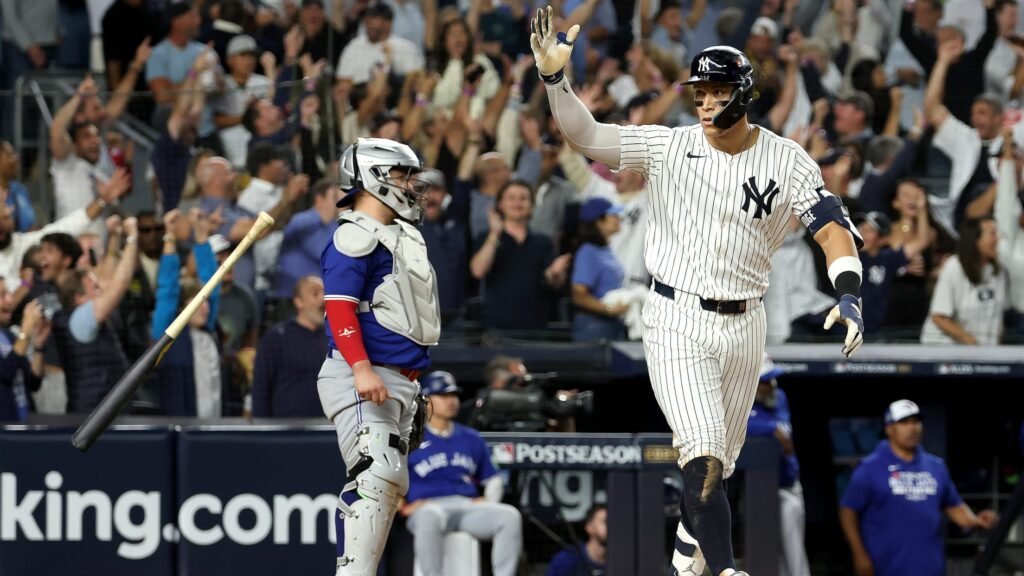
Judge captured the MLB batting title with a .331 average, demonstrating not just 80-grade power but pure hitting prowess. Despite being known for towering home runs, Judge showed he’s far from an all-or-nothing slugger as he consistently hit for a high average, spraying the ball to all fields. In fact, he led all of MLB in all three slash-line categories (AVG, OBP, SLG), posting a gaudy .331/.457/.688 slash line and a 1.145 OPS. That OPS was the best in baseball, underscoring that Judge was the most impactful hitter in the league on a per-plate appearance basis.
Of course, power was still a big part of Judge’s game. He crushed 53 home runs, leading the Yankees and second in the AL only to Raleigh’s 60. Judge’s 114 RBIs were also among league leaders, again trailing only Raleigh in the AL. Crucially, many of Judge’s homers came in clutch moments, fueling a Yankees offense that often leaned on their captain’s bat. He also scored 137 runs, topping the majors in that category as well, a testament to how often he was on base and driving New York’s offense. In every traditional measure of production whether it be batting average, homers, RBIs, runs, or OPS, Judge was at or near the top of the leaderboard, making an old-school case as strong as anyone’s.
Raleigh and Ramírez had excellent seasons by traditional stats, but they don’t quite measure up to Judge’s across-the-board excellence. Raleigh set a historic mark with 60 home runs (a new record for catchers) and a league-best 125 RBIs but hit only .247 and had a much lower .948 OPS. Ramírez was again a steady force, batting .283 with 30 homers and 85 RBIs, plus a notable 44 stolen bases, but his .863 OPS lagged well behind Judge’s. The table below summarizes the primary batting stats for the three finalists:
| PLAYER | TEAM | AVG | HR | RBI | OPS |
| Aaron Judge | Yankees | .331 | 53 | 114 | 1.145 |
| Cal Raleigh | Mariners | .247 | 60 | 125 | .948 |
| José Ramírez | Guardians | .283 | 30 | 85 | .863 |
As shown above, Judge’s advantage in average and OPS is significant. He was the only one of the three to hit over .300 (winning the batting title at .331) and the only one with an OPS above 1.000. While Raleigh’s 60 long balls grabbed headlines and Ramírez’s balanced contributions (including those 44 steals) showcased his all-around game, Judge’s blend of high-average hitting and elite power made him the most complete offensive force in 2025.
Advanced Metrics: Elite by Every Measure
What truly separates Judge in the MVP race is that every advanced metric agrees with the eye test: he was simply on another level. Start with OPS+ and wRC+, which adjust for park and league context. Judge posted a 215 OPS+ in 2025, meaning he was 115% better than the average hitter. His wRC+ was 204, indicating a similar level of adjusted dominance. For context, the next-best AL hitters were far behind. Raleigh logged a 161 wRC+ and Ramírez a 133 wRC+. In other words, Judge created over twice as many runs as a league-average player and substantially more than his MVP rivals, reflecting superior overall offensive value.
Perhaps most telling is WAR (Wins Above Replacement), the all-encompassing value metric. By WAR, Judge was not just the AL’s best, he was in historic territory. He led the league in WAR by both major versions, with 10.1 WAR (FanGraphs) and 9.7 WAR (Baseball-Reference). This means Judge was worth about 10 wins more than a replacement player, a mark rarely seen in modern baseball. Raleigh was the runner-up in AL WAR at 9.1 fWAR (7.3 bWAR) which is a fantastic season, yet still a full win behind Judge. Ramírez, by comparison, had around 6.3 fWAR, well back of the pace. The gap in value underscores how Judge’s superior OBP, slugging, and even defensive/baserunning contributions (he had 12 steals and played solid defense in right field when healthy) all added up to outsize impact. The chart below highlights just how far ahead Judge was in wRC+ and WAR:
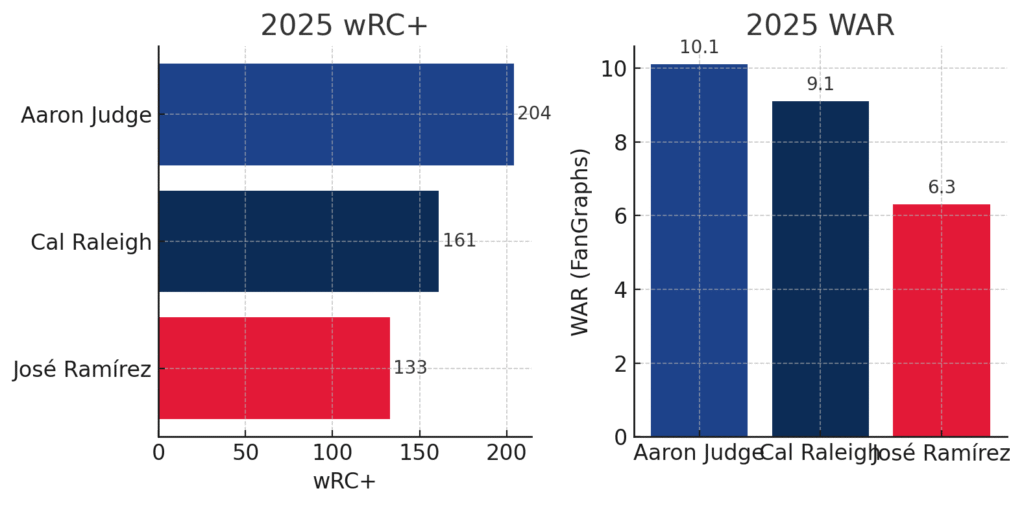
2025 wRC+ and WAR for AL MVP finalists. Judge’s offensive production (wRC+) and overall value (WAR) eclipsed that of Raleigh and Ramírez.
Beyond these aggregate metrics, Statcast data provides further evidence of Judge’s unparalleled performance. His quality of contact was simply on a different planet in 2025. Judge’s average exit velocity was 95.4 mph, the highest in the majors and well above both Raleigh (91.3 mph) and Ramírez (88.9 mph). He led MLB in Hard Hit Rate (58.2%) and Barrel Rate (24.7%), meaning no hitter squared up the ball as consistently or as forcefully as Judge did. Every time he stepped to the plate, there was a very high chance the ball would be scorched. Raleigh had an excellent 19.5% barrel rate and 49.6% hard-hit rate himself, but even those paled next to Judge’s towering Statcast numbers. Ramírez (7% barrel, ~37% hard-hit) was not in the same power-hitting class, his strengths lay elsewhere.
One advanced metric that encapsulates hitting quality is expected wOBA (xwOBA), which estimates a hitter’s results based on exit velocity and launch angle, removing defense from the equation. Judge’s xwOBA in 2025 was a stratospheric .476, by far the best in MLB. (His actual wOBA was .463, so he even underperformed his expected a bit. For comparison, Raleigh’s xwOBA was .384 and Ramírez’s .351. The gap here illustrates that Judge wasn’t just lucky or benefiting from Yankee Stadium’s short porch, he flat-out earned his results with elite contact. In fact, Judge’s .463 xwOBA was in the 100th percentile of all hitters. In every advanced category, from Statcast quality metrics to comprehensive value stats, Aaron Judge stood alone at the top.
Comparing the Finalists: Judge vs. Raleigh vs. Ramírez
All three AL MVP finalists had noteworthy seasons, and it’s instructive to compare their contributions directly. Cal Raleigh delivered a season for the record books as a catcher. His 60 home runs broke the single season record for a catcher as well as the Mariners’ franchise record. He played in 159 games (catching 128 of them), an ironman workload behind the plate, and drove in 125 runs. Raleigh was the middle-of-the-order force that led Seattle to its first AL West title since 2001. His impact on the Mariners’ lineup and pitching staff (with his game-calling) gives him an MVP narrative that’s hard to ignore. Offensively, Raleigh’s profile was power-centric: besides the 60 HR and .589 slugging percentage, he hit a modest .247 and reached base at a .359 clip. That resulted in a very good .948 OPS and 161 wRC+. However, those are clearly a step down from Judge’s numbers in everything but the HR and RBI columns. Raleigh’s season was historic for his position and brilliant in its own right, likely one of the best ever by a catcher, but when weighing total offensive contribution, he still falls short of Judge’s across-the-board supremacy. It’s telling that even with 7 more homers and 11 more RBIs, Raleigh’s OPS was nearly 200 points lower than Judge’s, due to the huge gap in batting average and on-base skill.
José Ramírez, meanwhile, turned in yet another well-rounded season that solidified his status as one of the game’s great all-around players. He hit .283 with 30 homers, 34 doubles, 85 RBIs, 103 runs, and swiped an AL-leading 44 bases. Ramírez’s blend of power, contact, speed, and defense at third base made him a true five-tool contributor. He was the catalyst for Cleveland’s offense and helped the Guardians repeat as AL Central champions (88–74). By most years’ standards, that’s MVP-caliber performance and indeed this will unquestionably be José Ramírez’s seventh top 6 MVP finish without a win. Yet, in 2025 he is likely a clear third in the voting. The reason is simply that both Judge and Raleigh had more eye-popping numbers. Ramírez’s OPS was about 280 points lower than Judge’s and his WAR roughly four wins fewer. While Ramírez was superb, he wasn’t as dominant in any one area as Judge was in essentially every area of hitting.
It’s also worth noting the team contexts for each player when assessing “value.” All three finalists played on teams that made the postseason, so none were compiling stats on non-contenders. Judge’s Yankees won 94 games (tied for the best record in the AL) and made the playoffs as a Wild Card, Raleigh’s Mariners won 90 games and took the AL West crown, and Ramírez’s Guardians won 88 games to top the AL Central. Each of these teams leaned heavily on their star. Seattle likely doesn’t break their 20+ year division title drought without Raleigh’s offensive explosions and steady presence behind the dish. Cleveland’s offense, which struggled at times, would have been pedestrian without Ramírez’s blend of power and speed sparking rallies. And the Yankees? Their lineup was decidedly average whenever Judge wasn’t in it. In fact, a midseason injury to Judge threatened to derail New York’s year when he missed a couple of weeks and was limited to DH duties for an extended stretch with a right flexor strain. During that period, the Yankees’ offense sputtered. Upon his return, Judge resumed his MVP form and the Yankees surged to secure a postseason spot. The value of Judge’s presence in the lineup was unmistakable, pitching staffs altered their approach and fans’ morale lifted when The Captain was penciled in.
Ultimately, in comparing the finalists, the debate comes down to storyline vs. statistics. Raleigh has the compelling narrative of a breakout, record-setting season by a catcher who lifted his franchise to new heights. Ramírez has the narrative of sustained excellence and do-it-all contributions for a division winner. Judge, however, offers both a narrative and clearly superior statistics. He’s the captain and face of the most storied franchise, who put up numbers reminiscent of legends and carried his team through adversity. And by the numbers, he has a discernible edge in nearly every category other than the raw homer and RBI totals, which he more than offsets with better rate stats and overall value. When weighing everything together, Aaron Judge stands as the best of the best among the 2025 finalists.
The Verdict: MVP for #99
When you compile the evidence, the conclusion becomes clear: Aaron Judge should be the 2025 American League Most Valuable Player. He excelled in traditional stats, winning a batting title and pacing the league in OPS while clubbing 53 homers. He dominated advanced metrics, from leading in WAR to posting off-the-charts Statcast numbers that underscore the quality of his performance. He outshined the other worthy finalists in nearly every facet, and he did so while carrying a playoff team and serving as its on-field and clubhouse captain.
To truly appreciate Judge’s 2025, it helps to put it in historical perspective. This is not simply a good player having a good year, it’s an all-time great player reaching new heights and etching his name alongside the legends of the game. Even within Judge’s own career, 2025 might be his finest work. That’s saying a lot, considering he was the AL MVP in 2022 with an AL record 62 home runs. In 2025, Judge didn’t quite match the raw home run total of 2022, but you could argue he was an even better overall hitter. His .331 average was significantly higher (he won his first batting title), and his 1.145 OPS edged out his 1.111 mark from 2022. The last Yankee to post an OPS this high in a season (min. 500 PA) was Mickey Mantle in 1961, until Judge did it in 2022 and 2025. In fact, Judge joined Mantle, Babe Ruth, Lou Gehrig, and Joe DiMaggio as the only Yankees to record multiple seasons with an OPS above 1.100. That’s the kind of company he’s keeping.
Speaking of those names (Ruth, Mantle, Gehrig, DiMaggio), Judge is steadily carving out his own Yankee legacy alongside them. This year he continued climbing the franchise leaderboards. In September 2025, he hit his 362nd career homer to pass DiMaggio for 4th on the Yankees’ all-time home run list. The top five Yankees HR hitters had remained the same since 1957, a who’s-who of baseball icons, until Judge muscled his way in. As manager Aaron Boone put it, “with what Aaron’s done…he’s been in some rarefied air…when you see a career list like that, with this organization, and where he is… it’s pretty awesome.” Judge is rewriting parts of the Yankee record books that had been untouched for generations. That historical significance will not be lost on MVP voters, who often consider a player’s season in the context of baseball lore.
It’s not just franchise history, Judge’s 2025 ranks among the great offensive seasons in MLB history. A 204 wRC+ is something baseball hasn’t seen in a full season in decades outside of Barry Bonds. His 10.1 WAR is the highest by any AL position player since the peak of Mike Trout (and even eclipses any of Trout’s individual seasons). In leading the league in batting average, OBP, SLG, OPS, and WAR, Judge effectively did it all, a combination of achievements that evokes memories of triple-crown winners and all-around superstars of yesteryear. Yankees Savant readers will appreciate that Judge’s season sits comfortably alongside the MVP years of Mantle in 1956 (when he won the Triple Crown) or Gehrig in 1927, or more recently, Miguel Cabrera’s 2013 or Trout’s 2018, as one of the defining offensive campaigns of this generation. The 2025 season will be talked about in New York for years, especially if it is capped with Judge taking home the MVP trophy.
Cal Raleigh’s record-setting power and José Ramírez’s dynamic season are commendable, but neither matches the complete package that Judge delivered. In the end, MVP voters have to ask: which player’s 2025 performance was most outstanding and most valuable to his team’s success? The answer, backed by both emotion and evidence, is Aaron Judge. The Bronx has witnessed an extraordinary season, and it deserves to be crowned with Judge’s third MVP award, placing him among just a dozen players in history with three or more, and cementing his place as an all-time Yankee great. The numbers, the context, and the intangible impact all paint the same picture: 2025 belongs to Aaron Judge, the rightful American League MVP.