

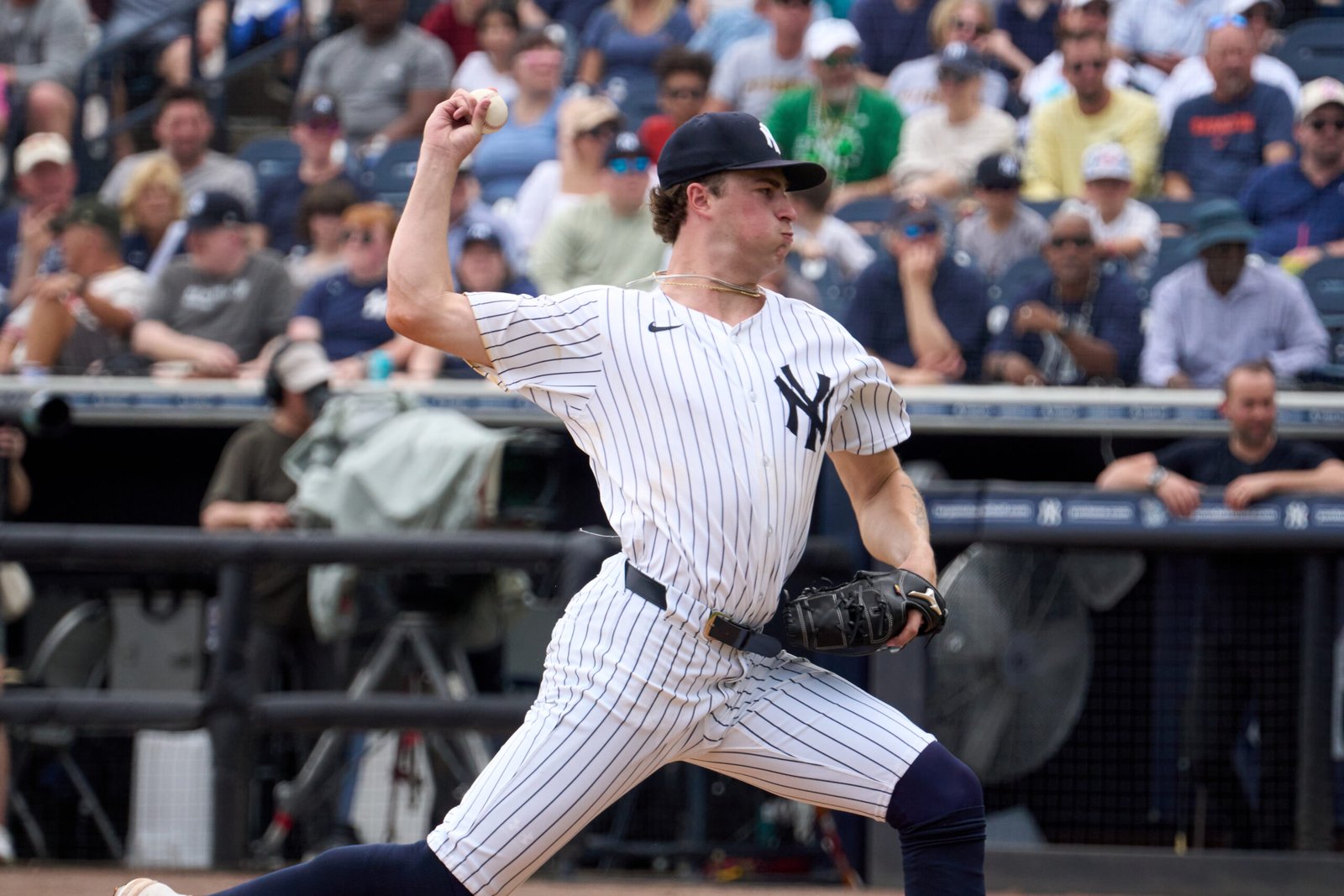
The 2026 New York Yankees enter spring training with a roster built around veteran star power, a few new acquisitions, and a large cluster of pitchers and role players competing for limited spots.
Unlike past seasons, the battles are less about stars and more about marginal gains such as the final outfielder, the last rotation spot, and the final two bullpen arms. These decisions will likely be driven by underlying metrics rather than traditional statistics.
This 4-part series breaks down each competition using FanGraphs and Baseball Savant data.
Everything comes with a giant asterisk: health.
Entering spring training, the Yankees list of starters that will open the season on the Injured List include Gerrit Cole, Carlos Rodón, and Clarke Schmidt. That reshapes the Opening Day pitching staff and creates opportunities for younger arms.
Projected Starting Rotation
Max Fried – The staff anchor. Fried gives the Yankees a legitimate No. 1 starter while the injured veterans work their way back. His ground-ball profile and command-driven approach make him the stabilizing force of the rotation.
Cam Schlittler – The breakout internal arm. Schlittler projects as a mid-rotation starter with swing-and-miss stuff, and the Yankees will likely give him every chance to seize a long-term rotation spot.
Luis Gil – High-octane upside. Gil’s fastball/slider combination gives him frontline stuff, but his longer-term role depends on strike-throwing consistency. If the command holds, he could outperform his rotation slot.
Ryan Weathers – The left-handed bridge starter. Weathers offers durability and a more contact-oriented profile. The Yankees will likely lean on him to absorb innings while higher-upside arms settle into roles.
Will Warren – The developmental starter. Warren’s pitch mix and command give him the tools to stick in the rotation, and 2026 looks like a proving ground season to determine whether he’s a long-term starter or future swingman.
Projected Bullpen
David Bednar – Primary closer. Bednar’s power fastball and high strikeout rates make him the logical ninth-inning option.
Camilo Doval – High-leverage fireballer. Doval’s elite velocity and movement profile make him a natural late-inning weapon, capable of handling either the eighth or ninth depending on matchups.
Fernando Cruz – Swing-and-miss specialist. Cruz’s splitter-driven arsenal gives the Yankees a strikeout option in key middle or late-inning situations.
Tim Hill – Left-handed situational arm. Hill’s ground-ball heavy approach makes him a matchup option against left-handed hitters in tight spots.
Paul Blackburn – Multi-inning bridge arm. Blackburn provides stability and length out of the bullpen, capable of handling two or three innings when the rotation exits early.
Cade Winquest – Upside middle reliever. Winquest brings swing-and-miss potential and could grow into higher-leverage innings if his command continues to improve.
Ryan Yarbrough – Bulk and flexibility piece. Yarbrough’s role will likely fluctuate between long relief, spot starts, and piggyback assignments depending on the health of the rotation.
Angel Chivilli – Power-arm development play. Chivilli’s upper-90s velocity fits the Yankees’ recent bullpen philosophy, and he projects as a middle-inning strikeout option with room to grow.
Projected Starting Lineup
(C) Austin Wells – The primary catcher and bottom-of-the-order contributor. Wells projects to continue to hold down the everyday role.
(1B) Ben Rice – Left-handed run producer. Rice offers on-base skills and power, giving the Yankees a younger, more flexible bat at first base and DH.
(2B) Jazz Chisholm Jr. – Athletic catalyst. Chisholm brings speed, power, and defensive range, giving the Yankees a dynamic presence at second base and near the top of the lineup.
(SS) Jose Caballero – Defense-first shortstop. Caballero provides speed and reliable infield defense, allowing the Yankees to prioritize run prevention up the middle until Anthony Volpe’s return from injury.
(3B) Ryan McMahon – Two-way stabilizer. McMahon brings above-average defense and left-handed power, offering balance and consistency at the hot corner.
(LF) Cody Bellinger – Middle-of-the-order left-handed force. Bellinger’s power, on-base ability, and defensive flexibility make him one of the most important everyday players on the roster.
(CF) Trent Grisham – Defense and power in the middle. Grisham’s center-field range paired with his 2025 power surge gives the Yankees a rare two-way contributor in center.
(RF) Aaron Judge – Franchise cornerstone. Judge remains the offensive engine of the lineup, anchoring the order with elite contact quality and MVP-level production.
(DH) Giancarlo Stanton – Primary designated hitter and power threat. Stanton’s role is simple: stay healthy and provide middle-of-the-order thump.
Projected Bench
Ahmed Rosario – Utility contact bat. Rosario offers positional flexibility across the infield and outfield, along with a contact-oriented approach off the bench.
Paul Goldschmidt – Veteran right-handed bat that still destroys southpaws. Goldschmidt gives the Yankees a professional at-bat, platoon potential, and clubhouse leadership.
Oswaldo Cabrera – Defensive Swiss Army knife. Cabrera’s ability to play nearly everywhere makes him a key late-inning defensive and matchup piece.
Fourth Outfielder TBD (External Addition) – Role-specific acquisition. The Yankees are likely to target a glove-first or speed-oriented outfielder via trade to round out the roster and provide late-inning flexibility.
Final takeaway
This roster isn’t being decided by superstar battles. It’s being shaped at the margins:
- The last outfielder
- The final bench piece
- The final bullpen arms
And those decisions will likely come down to:
- Strikeout rates
- Whiff profiles
- Defensive metrics
- Roster flexibility
In other words, the 2026 Yankees will be built not just on star power, but on analytical edges in the final three roster spots.
Comments are closed