The New York media has been busy scrutinizing the dismissal of Yankees international scouting director, Donny Rowland, which was first reported by Francys Romero. Rowland’s contract expired this offseason, and General Manager Brian Cashman chose not to renew it. Rowland had spent 23 years with the Yankees, including 15 in his last position, overseeing the signings of players like Jasson Dominguez, Roderick Arias, Alexander Vargas, Brando Mayea, Raimfer Salinas, and Antonio Gomez.
Cashman explained the decision, stating: “Like anything else, you gotta make some very difficult decisions. I’ve been involved with Donny Rowland for a long time. Obviously, we have worked alongside each other for a long time, and he’s run the department for quite some time. But fork in the road, contract had expired, and so I made the difficult decision to look for a different lead voice in that chair. So that’s what we’re doing at this stage.”
It is important to remember that predicting the success of young professional athletes is incredibly challenging, especially for international prospects – even more so than American amateur prospects.
The International Prospect Development Process
- Early Scouting: Handshake deals with academies are often made when a potential prospect is between 12 and 14 years old. Scouting at this stage is similar to U.S. combines, and the financial side is a separate, complex issue.
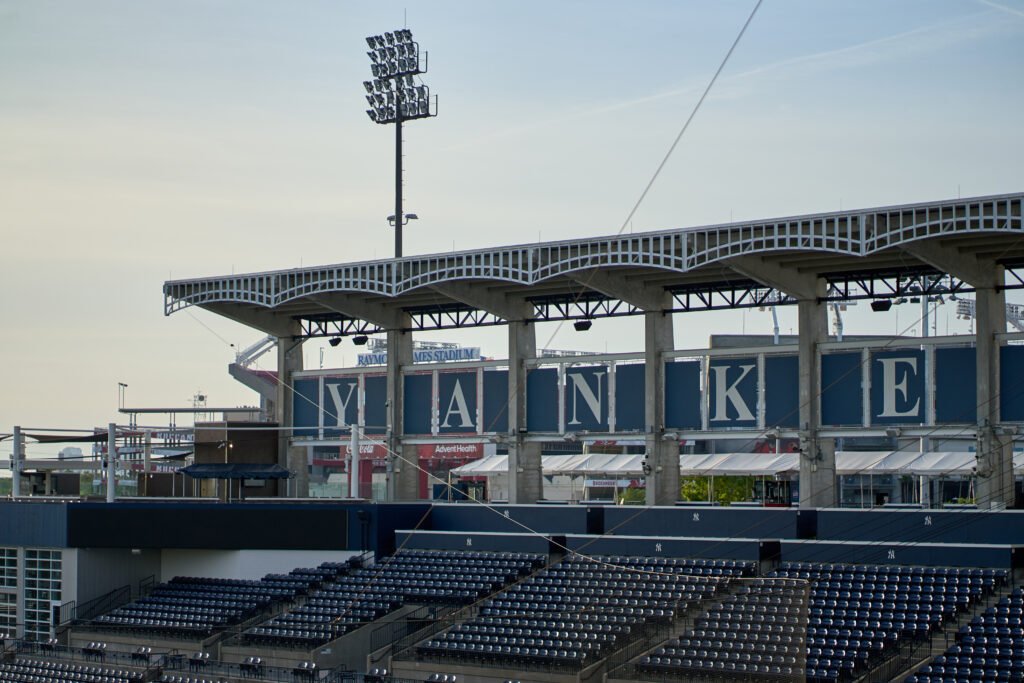
- Organized Play: Once signed and training with the team, these prospects are first introduced to organized play. Many have never even stepped foot in a professional baseball stadium before, only seeing one when they watch a local game, such as the Tarpons at Steinbrenner Field.
- The Dominican Summer League (DSL): This is where prospects get their first taste of meaningful organized competition. The Yankees field two teams, the NYY Bombers and the NYY Yankees, in Boca Chica. Most “household names” have played here, with Jasson Dominguez being a notable exception due to the 2020 COVID shutdown.
- Florida Complex League (FCL) & Low-A (Tampa): This level is a major transition, moving international prospects from the Dominican Republic complex to US facilities in Florida. It’s their first time joining American counterparts, requiring adjustment to a new country, culture, and a higher, more intense level of competitive baseball and structured development crucial for integrating them into the minor league system. This stage is a significant period of adjustment, as they are first exposed to American media, scouts, and way of life. The Yankees provide assistants to help with navigation, including English lessons. Being in the Tampa area, with its large Hispanic community, is beneficial as they can still find familiar food and products.
- High-A and Beyond: Moving up to these levels is the true test, as they leave the tropical climate they are accustomed to and face much larger crowds, especially in the Northeast. Even in Florida, they can be seen bundled up in April.
From a business perspective, financial risk is a key consideration. Investing $4 million in a single American prospect is often seen as a safer bet than investing that same amount across three international prospects. While there is a greater potential return on the smaller investment of an international prospect (some sign for as little as $10,000, like Carlos Lagrange in 2022), the risk of them not developing as forecasted is higher due to the extremely early age at which they are scouted.

Alexander Vargas, a Cuban shortstop who signed with the Yankees for $2.5 million in 2018, is often discussed in these articles. He was competing for playing time with George Lombard Jr. in Somerset. Although Vargas was eventually released by the Yankees, his performance was arguably better, as he posted a higher batting average and a similar slash line (.227/.299/.333/.632) compared to Lombard’s (.204/.319/.339/.658). However, it should be noted that Vargas had been in the system for six years, including three full seasons, two short seasons, and a partial season in 2024 due to injury at the time of his release.
The Yankees’ handling of Dominican shortstop Roderick Arias is noteworthy. Despite a strong finish to the 2024 season, which led many to believe he was deserving of a High-A assignment in 2025, he was held back. This decision likely stems from his defensive “rough edges”; at SS, he has a career fielding percentage of .920, over 1798-1/3 innings. Arias struggled early in the 2025 season, appearing lost at the plate. In April, he managed only 11 hits (including four doubles and a home run) across 71 at-bats, resulting in a .155 batting average and a .556 OPS. However, he rebounded, again finishing the season strong by going 6-for-22 (.318/.483/.545/1.028) with a double, six walks, and a hit-by-pitch. The Yankees’ internal data, which remains confidential, would shed more light on the decision on why Arias didn’t make the jump to High-A in 2025.
However, Arias and the previously mentioned Vargas share a pattern in how they were treated compared to their American-born shortstop counterparts. Both Arias and Lombard were with the Tarpons at the end of the 2024 season, but Lombard was promoted to High-A for 2025, while Arias remained. A similar situation occurred with Vargas and Sweeney; Vargas finished the season in the FCL while Sweeney was promoted, ultimately putting Sweeney about a level ahead. To be fair, Vargas struggled, hitting the Mendoza line in 2022 (Tampa) and 2023 (Hudson Valley), while Sweeney was hitting around .240.
It is worth noting that the Latin players’ limited exposure to organized baseball may explain why they were handled somewhat differently than their American peers. Not every prospect will fly through a farm system like Juan Soto did with the Nationals’ system. Even on the American side, the way Toronto moved Trey Yesavage through their system in 2025 was remarkable.
In contrast, the release of Venezuelan Raimfer Salinas was more surprising. Salinas had a career slash line of .236/.326/.379/.705 and ended the 2022 season very strongly, going 10-for-26 in his final 10 games with 1 double, 2 home runs, 5 RBI, and 4 walks (.385/.469/.615/1.084). After playing just one game in 2023, Salinas was released by the Yankees. He wasn’t a standout prospect, and his path to playing time, particularly in his preferred center field, was blocked following the 2022 drafting of Spencer Jones. Despite this, Salinas demonstrated solid defense in right field, recording a .974 fielding percentage with only 2 errors across 351 2/3 innings and 76 total chances.

Antonio Gomez, a prospect with a unique history, was originally signed out of Venezuela by the Yankees for $600,000 as a catching prospect. However, the Yankees recently changed his role, converting him back to a pitcher. Gomez told me in 2021 that he used to be a pitcher when he was growing up in Venezuela, before the academy turned him into a catcher, potentially to manage control issues while utilizing his high power arm to catch runners stealing. His time as a catcher was marked by struggles. In 2021, he missed significant time due to vision problems, finishing the season wearing glasses. As he advanced in the system, his hitting lagged, resulting in a poor .030/.158/.152/.309 slash line, going just 1-for-33 with a single and five walks before the conversion. As a pitcher, Gomez’s statistics are also poor, having allowed six earned runs on six hits over 2 ⅔ innings in four appearances, resulting in a 20.25 ERA. While there is clearly much more development needed, it’s also relevant to note he went on the injured list shortly after his final relief appearance in August. Gomez elected free agency on November 6th, but was re-signed by the Yankees just four days later.
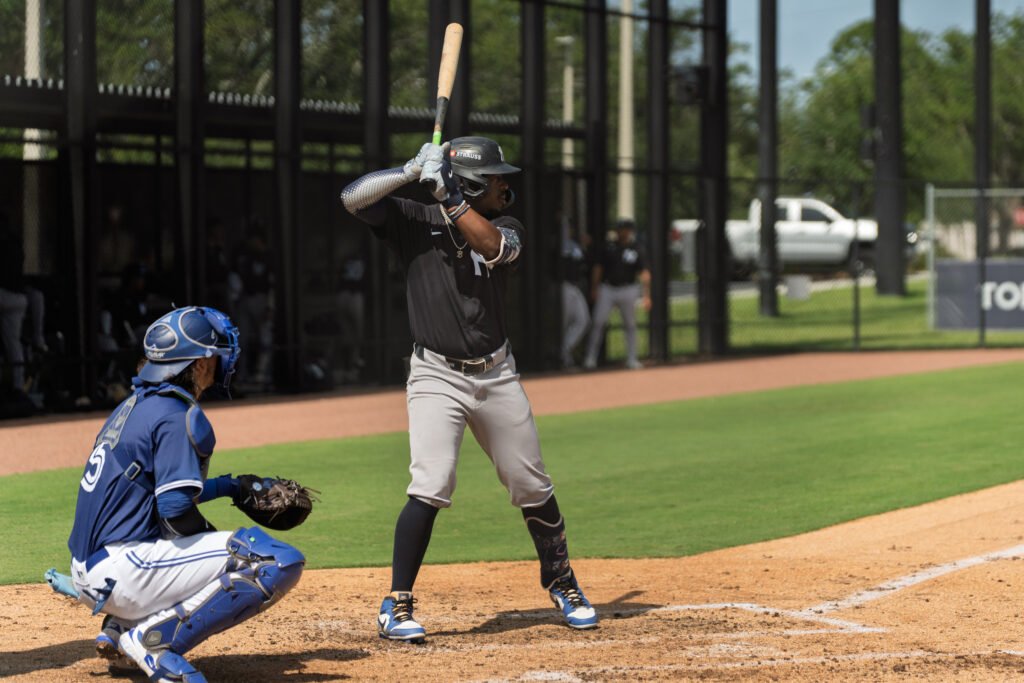
Brando Mayea is another prospect whose limited playing time in the U.S. has drawn criticism. This is primarily due to a series of injuries and the exceptionally short season in the Complex League, where he has been playing. Despite these setbacks, I consider Mayea one of the best well-rounded outfield prospects in the system, noting that his routes are cleaner and more efficient than those of Jasson Dominguez. In the 20 games he played in 2025, Mayea batted .297 with 9 RBIs before sustaining an ankle injury. I am hopeful the Yankees will give Mayea a clear path for development in the coming years, while also helping him manage and prevent injuries. Given his quick return to the batting cage after the ankle injury, I expect him to join the Tarpons in the Steinbrenner Field outfield next season.
No responses yet