
2026 MLB Draft Profile: Daniel Cuvet – Miami’s Power Hitting Corner Infielder
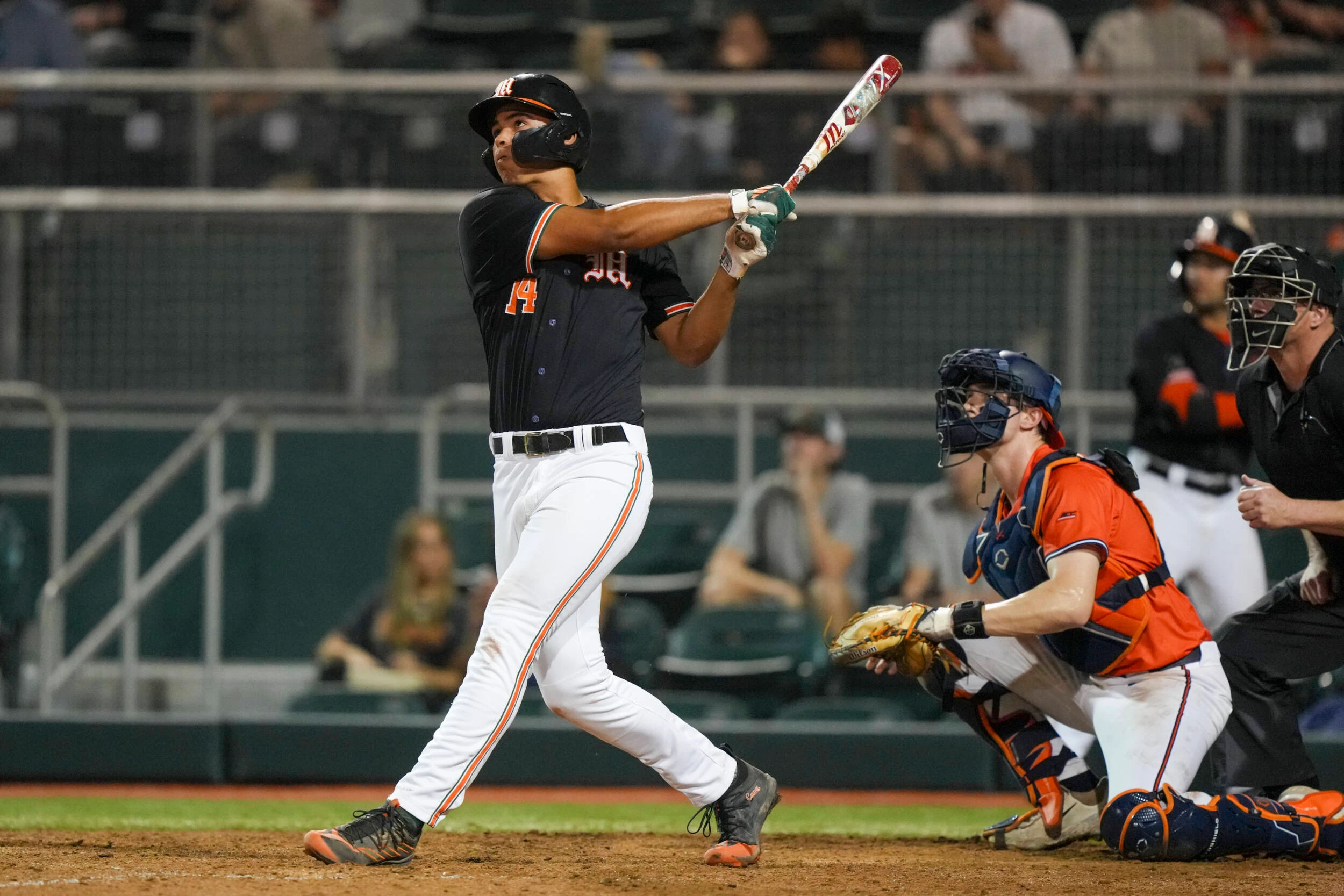
The New York Yankees have long prioritized impact bats with power potential, particularly players who profile well with modern analytics and the organization’s player development philosophy. One name that increasingly fits that mold is Daniel Cuvet, the powerful corner infielder from the University of Miami. As the 2026 MLB Draft approaches, Cuvet is emerging as one of the most intriguing college hitters in the class, and a player whose profile aligns almost perfectly with what the Yankees typically value.
For an organization constantly seeking the next middle-of-the-order threat, Cuvet represents a compelling blend of raw power, advanced approach, and data-backed offensive upside.
A Middle-of-the-Order Bat at Miami
Daniel Cuvet arrived at the University of Miami as one of the most highly regarded hitters in the Hurricanes’ recruiting pipeline and quickly cemented himself as a lineup cornerstone. Listed around 6-foot-3 and 215 pounds, Cuvet brings a physical frame that scouts associate with future professional power production.
At Miami, Cuvet has been deployed primarily as a third basemen, with occasional DH reps, a common path for college power hitters transitioning to pro ball. What stands out immediately in Cuvet’s profile is the way his bat speed and leverage translate into consistent hard contact. His swing generates natural loft, and he shows the ability to drive the ball to all fields, an important trait for projecting success at higher levels.
In the ACC, one of college baseball’s most competitive conferences, Cuvet has consistently demonstrated the ability to hit premium pitching. That success against elite competition significantly boosts his draft stock.
The Power Profile the Yankees Love
If there is one trait that would immediately appeal to the Yankees’ front office, it is Cuvet’s power metrics. New York’s modern scouting process leans heavily on exit velocity, barrel rate, and launch-angle optimization, metrics that correlate strongly with future MLB power production. Cuvet checks many of those boxes.
Scouting reports frequently note that Cuvet produces plus raw power, with batting practice displays that can reach the deepest parts of the park. More importantly, his power plays in games rather than just workouts.
Several evaluators project 25–30 home run upside at the professional level, especially if his swing path continues to produce consistent lift and backspin.
For a Yankees team that plays half its games at Yankee Stadium, Cuvet’s right-handed power could translate particularly well. His ability to drive balls to the left-center gap and pull side suggests the potential to take advantage of the stadium’s favorable dimensions for right-handed hitters.
Advanced Approach at the Plate
Power alone does not guarantee success in professional baseball. What separates Cuvet from many power-focused college hitters is his mature plate discipline and strike-zone awareness.
Cuvet has demonstrated:
- Strong walk rates
- Controlled aggression early in counts
- The ability to adjust against offspeed pitching
Rather than selling out for home runs, he shows a willingness to take pitches and work counts, traits that align with the Yankees’ analytical hitting philosophy. This approach could allow Cuvet to maintain respectable on-base percentages, even as he transitions to higher levels of pitching.
Another encouraging indicator is his contact quality against velocity. Scouts have noted that his swing mechanics allow him to stay through the zone longer than many college power hitters, helping him handle fastballs in the mid-to-upper 90s.
That skill is critical for projecting success against professional pitching.
Defensive Projection
Defensively, Cuvet’s long-term home will likely determine his ultimate value.
At Miami, he has spent most his time at third base, where his arm strength is adequate and his hands are serviceable. However, some scouts believe his future may ultimately be at first base, depending on how his body develops.
Even if he shifts across the diamond, the Yankees have historically shown a willingness to draft bat-first corner infielders if the offensive ceiling is high enough.
With players like Aaron Judge and Giancarlo Stanton anchoring recent lineups, the Yankees have never shied away from prioritizing offensive firepower. If Cuvet’s bat reaches its projected ceiling, defensive questions will matter far less.
Fit With the Yankees’ Player Development System
The Yankees’ player development pipeline has increasingly focused on maximizing offensive traits through data driven instruction.
In recent years, the organization has invested heavily in:
- Bat speed training
- Swing optimization
- Advanced pitch recognition tools
- Biomechanics analysis
Cuvet’s swing already features many traits the Yankees typically try to build in hitters such as natural loft, strong rotational power, and consistent barrel control. That foundation makes him an ideal candidate for the Yankees’ development staff to further refine.
Additionally, the Yankees have shown an increased willingness to target polished college hitters early in the draft, believing that their advanced approach can allow them to move through the system faster. Cuvet fits that profile well.
Projected Draft Range
Most early projections place Cuvet somewhere in the late first to early second round range, though strong ACC performance could push him higher. For the Yankees, whose draft position often lands toward the back of the first round due to competitive success, this range could align perfectly.
If Cuvet is still available when New York picks at 25, he would represent a high-upside offensive selection with relatively low developmental risk compared to many prep hitters.
Ceiling and MLB Projection
At his best, Daniel Cuvet projects as a power hitting corner infielder capable of anchoring the middle of a lineup.
A realistic major league outcome could resemble:
- .250–.265 batting average
- .340+ on base percentage
- 25–30 home runs annually
- Strong run-production totals
That type of player holds tremendous value in modern baseball, particularly in a lineup designed around power and on base skills.
For the Yankees, whose identity has long revolved around impact bats and offensive depth, Cuvet represents the type of hitter who could eventually carry that tradition forward.
Final Thoughts
Drafting is always about projecting future value, and Daniel Cuvet’s profile checks many of the boxes the Yankees prioritize: power, plate discipline, and data-supported offensive upside.
While defensive questions remain, his bat alone could make him one of the most appealing college hitters in the 2026 class. If the Yankees are looking to add another potential middle-of-the-order slugger to their pipeline, Daniel Cuvet should be firmly on their draft board. And if his development continues on its current trajectory at Miami, he may not stay available for long.