
Austin Wells Has Become One of the Most Important New York Yankees Players
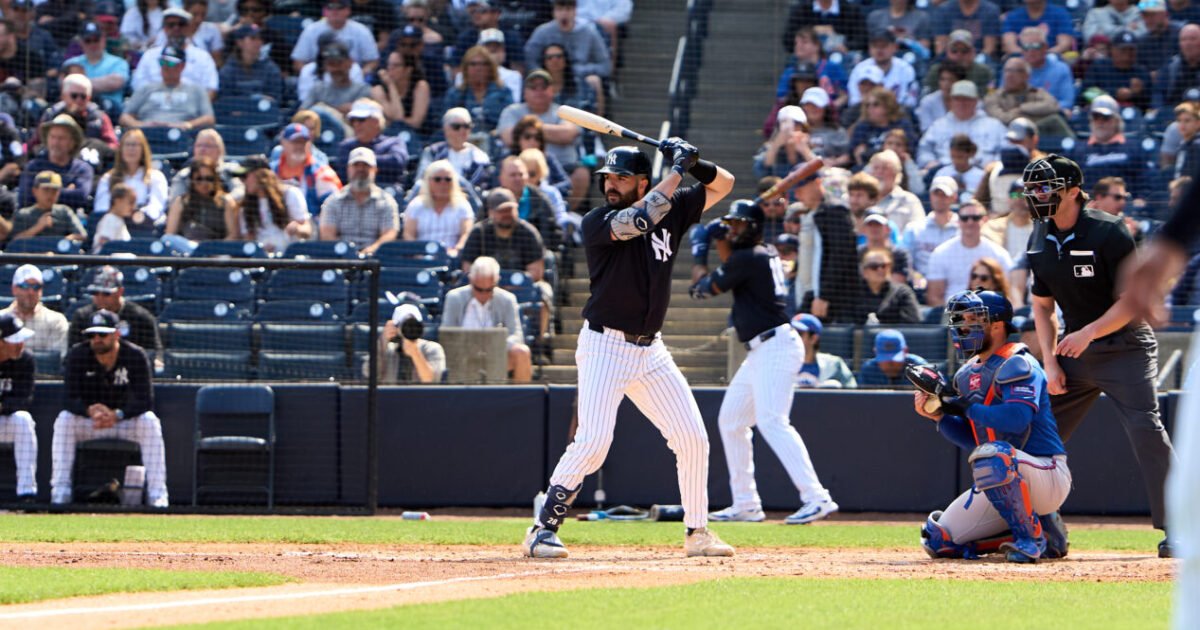
For years, the New York Yankees searched for stability behind the plate. They cycled through veterans, defense-first backups, and short-term stopgaps trying to find a catcher who could contribute on both sides of the ball. Now, they may have finally found their answer in Austin Wells. The analytical case suggests he is quietly becoming one of the most important players on the roster.
Wells may not yet receive the same headlines as stars like Aaron Judge or Cody Bellinger, but his value to the Yankees extends far beyond the traditional box score. In today’s game, where teams increasingly emphasize framing, pitch calling, and offensive production from premium defensive positions, Wells is emerging as one of the more complete young catchers in baseball.
The biggest reason why starts with his defense. Catcher defense is notoriously difficult to quantify publicly, but nearly every available metric suggests Wells is already among baseball’s better defensive backstops. According to Baseball Savant, Wells ranked among the top framing catchers in baseball during the 2025 season, finishing third in catcher framing runs. His +12 framing runs from last year placed him in elite company and reinforced what Yankees pitchers and coaches have consistently praised: Wells has a natural ability to steal strikes on the edges and control the game behind the plate.
That matters more than casual fans often realize. Elite framing can save multiple runs over the course of a season, directly impacting pitcher performance and game outcomes. For a Yankees organization built heavily around power pitching, having a catcher who maximizes strike calls is invaluable.
But Wells is not simply a glove-first catcher. Offensively, while his overall numbers may not jump off the page at first glance, his profile suggests there is more upside than many realize. In 2025, Wells hit 21 home runs in 448 plate appearances, a tremendous total for a catcher, especially one still in his developmental years. Power from the catcher position remains one of baseball’s rarest commodities, and Wells has already demonstrated above-average slugging ability for the role.
More importantly, the underlying data shows his raw power is legitimate. According to Baseball Savant, Wells posted a 90.6 mph average exit velocity, 45.2% hard-hit rate, and 10.2% barrel rate in 2025. Those are highly encouraging metrics, especially for a catcher, and suggest Wells is making quality contact even when the results may not fully reflect it.
Yes, his offensive production remains somewhat inconsistent. Wells posted just a .219 batting average and a 94 wRC+ in 2025, meaning he was slightly below league average offensively overall. However, context matters. Catchers across baseball are generally weaker hitters than other position players due to the physical demands of the position. When a catcher can provide even average offense while playing plus defense, that player becomes extremely valuable.
That is reflected in Wells’ WAR totals. FanGraphs credited him with 3.0 fWAR in 2025, an excellent mark for a young catcher and a number that places him firmly in “above-average starter” territory already. For perspective, a 3-WAR catcher is often viewed as one of the better regulars at the position league-wide.
The exciting part for the Yankees is that Wells may still be scratching the surface. He will play most of the 2026 season at just 26 years old, which is still relatively young for a catcher. It’s a position where players often develop more slowly due to the mental and defensive demands required. His offensive plate discipline dipped somewhat last year, but if he can regain the patient approach he showed earlier in his development while maintaining his current power output, Wells has legitimate All-Star upside.
There is also the less measurable component that Yankees staff continually rave about: leadership. Handling a pitching staff is one of the most important responsibilities of any catcher, and by all accounts, Wells has earned the trust of the Yankees’ veteran arms. He started all seven postseason games behind the plate in 2025, a telling sign of the confidence the organization has in him.
Ultimately, Wells may never become a superstar in the traditional sense. He may never hit 35 home runs or contend for an MVP. But he does not need to. If Austin Wells continues producing 20+ home run power, elite framing, above-average defense, and strong clubhouse leadership, he will remain one of the most valuable catchers in the American League and one of the most important foundational pieces of the Yankees’ future. For a franchise that has spent years searching for long-term answers at catcher, the Yankees may finally have one. And if the underlying metrics continue trending upward, Austin Wells might soon become one of the most underrated stars in all of baseball.