
The New York Yankees Next Homegrown Core Is Emerging

For the better part of the last decade, the New York Yankees have been defined by star power. From Aaron Judge anchoring the lineup to high-priced additions filling in around the margins, the organizational identity has leaned heavily on proven major league production. But early in 2026, something different is beginning to take shape. Beneath the surface of a contending roster, a new foundation is forming. It’s one not driven by external acquisitions, but by internal development.
This isn’t just about a few hot starts. It’s about a group of players such as Ben Rice, Will Warren, Cam Schlittler, and a rising wave of top prospects like Carlos Lagrange, Elmer Rodríguez, and George Lombard Jr. The latter of the list has underlying metrics suggesting that the Yankees may finally be building a sustainable, homegrown core designed for the modern game.
Ben Rice’s emergence is perhaps the most visible sign of this shift. While his early-season production has been strong on the surface, the advanced data paints an even more compelling picture. Rice is consistently producing impact contact, with an average exit velocity sitting in the low-90s and a hard-hit rate pushing beyond 50%. More importantly, he’s doing it without sacrificing plate discipline. His chase rate remains comfortably below league average, and that combination (selectivity paired with power) is what drives his expected metrics into premium territory. With an xwOBA trending north of .350 and a strong expected slugging profile, Rice is beginning to look less like a complementary bat and more like a legitimate middle-of-the-order presence. His ability to spray line drives across the field rather than relying solely on pull-side power only reinforces the sustainability of his approach. For a Yankees team that has often skewed toward three-true-outcome hitters, Rice represents a more balanced offensive evolution.
On the pitching side, Will Warren is quietly becoming one of the most important developments on the roster. Long viewed as a depth option, Warren’s underlying profile suggests something closer to a reliable mid-rotation arm. His pitch mix which is headlined by a riding fastball and a high spin breaking ball, has translated into strong bat missing ability early on. He’s generating a whiff rate in the upper 20% range while keeping hitters uncomfortable with a chase rate above league average. What stands out most is his ability to limit quality contact. Opponents are struggling to square him up, with average exit velocities allowed sitting below league norms and a hard hit rate hovering around or below 40%. When paired with improving strike throwing and a strikeout rate trending toward 24-26%, Warren’s FIP and xERA indicators suggest a pitcher outperforming traditional expectations. In previous seasons, the Yankees would have needed to look externally for this type of stability. Now, they may already have it in house.
Cam Schlittler represents the higher octane version of that same developmental success. If Warren is the model of command and pitchability, Schlittler is pure power. Sitting comfortably in the upper 90s with his fastball and generating above average induced vertical break, Schlittler fits perfectly into the Yankees’ modern pitching philosophy: attack hitters at the top of the zone and miss bats at an elite rate. Early data supports the profile. His whiff rate has climbed past 30%, and his strikeout rate is trending well above league average. Even more encouraging is how his secondary arsenal is developing. His slider has already shown the ability to serve as a putaway pitch, generating swings and misses in two strike counts while expanding the zone. When combining that with a chase rate that continues to rise and contact suppression metrics that limit damage when hitters do connect, Schlittler’s expected indicators (xERA, xBA allowed) point toward a pitcher with real top end upside. This isn’t just your traditional starter’s profile; it’s the framework of a high impact arm who could anchor a staff in the near future. With Gerrit Cole and Max Fired in the mix, that’s quite a statement.
What makes this group even more compelling is that it doesn’t stop at the major league level. The pipeline behind them may be just as intriguing, starting with Carlos Lagrange. Few arms in the system can match Lagrange’s raw stuff. His fastball velocity routinely reaches the upper 90s and has touched triple digits, and when paired with a sharp breaking ball, the ingredients for dominance are obvious. The challenge, as reflected in his minor league data, has been consistency. His strikeout rates have been eye opening, often well above 30%, but they’ve come with elevated walk rates that inflate his WHIP and limit efficiency. Still, from an analytical standpoint, Lagrange represents exactly the type of high variance, high reward arm teams covet. If the Yankees’ development system can refine his command even marginally, the underlying traits suggest a pitcher capable of generating elite swing-and-miss at the major league level.
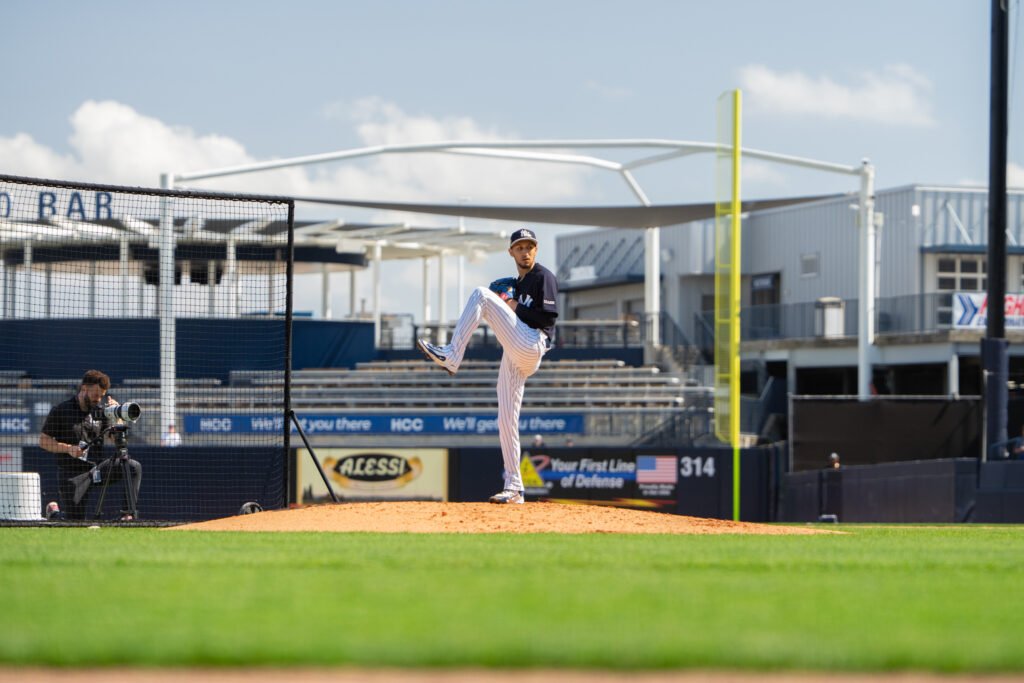
Elmer Rodríguez offers a different, but equally intriguing, profile. Where Lagrange is defined by raw power, Rodríguez brings a more polished mix of command and pitchability, combined with enough velocity to remain impactful. His fastball sits in the mid 90s, and he complements it with a diverse secondary mix that allows him to keep hitters off balance. In the minors, Rodríguez has demonstrated an ability to generate both strikeouts and weak contact, with underlying metrics pointing to a balanced approach rather than reliance on a single pitch. His strikeout-to-walk ratios have been more stable, and his ability to sequence pitches suggests a higher floor as a potential starter. From an organizational perspective, having both archetypes, Lagrange’s upside and Rodríguez’s stability, adds critical depth to the Yankees’ long-term pitching outlook.
Then there’s George Lombard Jr., who may ultimately be the most important position player prospect in this emerging wave. Lombard brings a well rounded skill set that aligns perfectly with the modern offensive profile the Yankees are trying to build. Early minor league data shows a hitter with advanced swing decisions, maintaining a strong walk rate while keeping his chase rate in check. These traits often translate well as players climb the ladder. His contact quality is trending upward as well, with improving exit velocities and a growing ability to drive the ball with authority, particularly to the pull side. While he may not project as a pure power bat at this stage, his combination of on base ability, developing pop, and athleticism gives him a path to becoming a high value everyday player. Add in defensive versatility and baserunning value, and Lombard fits the mold of a multi-dimensional contributor rather than a one tool specialist.
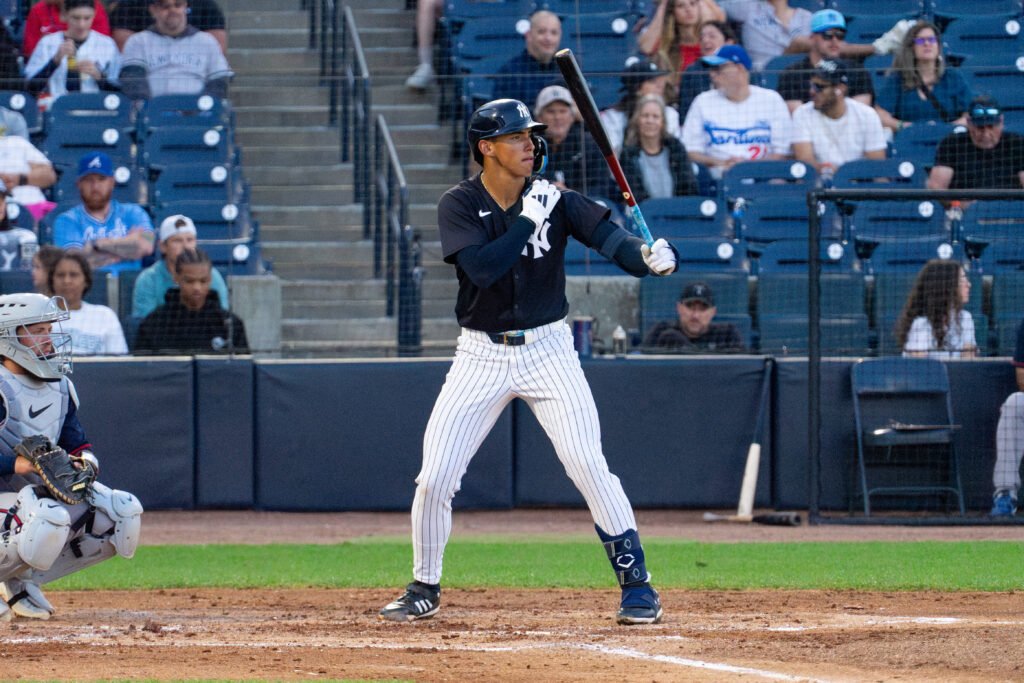
Taken together, this group represents more than just a collection of promising players. It reflects a structural shift in how the Yankees are building their roster. For years, success has been tied to external spending and headline acquisitions. Now, there is growing evidence that the organization is capable of developing impact talent internally. Players whose advanced metrics align with modern success indicators, from quality of contact on offense to bat missing ability on the mound.
This doesn’t mean the Yankees will abandon their traditional approach. Stars will always have a place in the Bronx. But what’s changing is the foundation beneath them. Instead of filling gaps each offseason, the Yankees may finally be generating solutions from within. Producing players who not only contribute but do so with underlying profiles that suggest sustainability.
It’s still early, and the league will adjust. But the data behind Ben Rice, Will Warren, and Cam Schlittler coupled with upside of Carlos Lagrange, Elmer Rodríguez, and George Lombard Jr. suggest this is more than a small sample surge. It may be the early stages of the Yankees’ next core taking shape. And if that’s the case, the rest of baseball may be watching the beginning of something much bigger than just a strong start to 2026.