
How The New York Yankees Turned Ryan Weathers Into Weapon
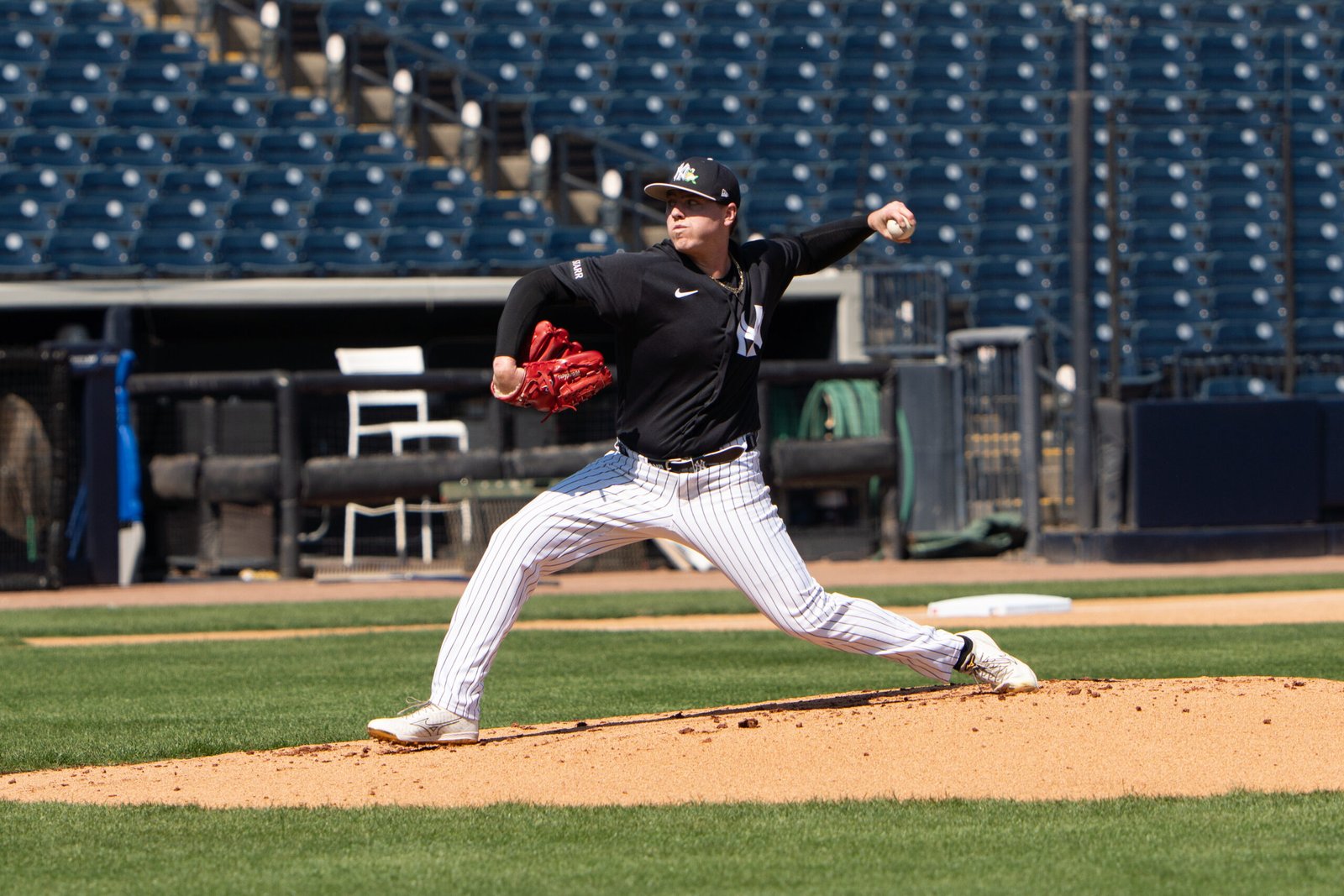
A velocity spike and a redesigned arsenal have transformed a reclamation flier into one of the most impactful trades of the offseason. When the Yankees sent four prospects to Miami for Ryan Weathers in mid-January, the move barely registered as more than depth insurance. The left-hander was coming off a season lost almost entirely to a flexor strain and a lat strain, carrying a 4.93 career ERA across parts of five seasons in San Diego and Miami. He profiled as a back-of-the-rotation flier who could be optioned if things went sideways, exactly the kind of low-cost bet a contender makes to survive April.
Four months later, that bet looks like one of the smartest pieces of business the front office did all winter. MLB Network’s Joel Sherman recently named it the third-most impactful trade of the offseason, and the underlying numbers explain why: through ten starts, Weathers carries a 3.14 ERA with 65 strikeouts against just 16 walks over 57 innings. For a rotation that has weathered injuries to nearly every veteran arm, he hasn’t been a stopgap, he’s been a stabilizer.
This is the story of how the Yankees’ player development machine took a perennial reclamation project and unlocked the version scouts dreamed about when San Diego made him the seventh overall pick in 2018.
The setup: depth that became a necessity
The Yankees acquired Weathers to backfill a rotation that projected to open the year shorthanded, with Gerrit Cole, Carlos Rodón, and Clarke Schmidt all rehabbing from surgical procedures. Weathers came cheap (roughly $1.35 million in 2026), with two arbitration years and a remaining option that hands the club real roster flexibility. He’s controllable through 2028, and as the son of David Weathers, who pitched for the 1996 championship club, he arrives with a Bronx footnote attached.
What the Yankees needed was someone to hold the line. What they got was a frontline-caliber run of starts that has helped a banged-up unit post the best rotation ERA in baseball (2.98 entering late May) and the most fWAR (7.5) of any staff in the game, despite never being at full strength.
The velocity: a real jump, with a caveat
The first thing that jumped off the page in spring was the radar gun. Weathers averaged in the high-96s on his four-seamer in 2025; this year he’s been sitting meaningfully harder, touching as high as 99 mph in his Yankees debut and running an average roughly two to three ticks above his old baseline. For a pitcher whose stuff was already firm by left-handed standards, he’d have ranked second among lefty starters in fastball velocity in 2025 had he qualified. That’s a genuine uptick.
The honest caveat: velocity alone has never been Weathers’s problem. His four-seamer has historically been hard but hittable, generating below-average whiff rates, and at least one analyst cautioned in March that the early-spring readings might not hold across a full season. The velocity matters, but it’s not the headline. The headline is what the Yankees did with the rest of his mix.
The redesign: where the breakout actually lives
This is the part that should excite any reader who cares about pitch shape over box-score lines. Working with pitching coach Matt Blake’s pitch-design lab, Weathers came out of camp with a materially different arsenal, anchored by a lowered release point, roughly two inches down on the four-seam, that cascaded through everything else:
- Sinker: Added around three inches of arm-side run, with one early start clocking 18.5 inches of horizontal movement. Crucially, the Yankees asked him to throw it far more often. In Miami he used it about 4% of the time despite favorable grades on it.
- Sweeper: Picked up roughly five additional inches of sweep, turning a solid breaker into a genuine put-away weapon against same-handed hitters.
- Slider: Gained about 3.5 inches of depth and three more inches of sweep, giving him a second distinct shape to attack the bottom of the zone.
- Changeup: Added about two inches of depth to a pitch that was already a career-long plus offering.
The throughline is intent. Where the old Weathers was a four-seam-heavy lefty who lived up in the zone and got beat, the new version is sinker-and-sweeper-oriented, designed to generate chase and ground balls and to reserve the riding four-seam as a selective change-of-eye-level pitch up top. It’s a modern reimagining of the crafty lefty, depth of repertoire and sequencing over pure power.
The result that matters most: the platoon split is gone
If you want a single data point that explains the breakout, look at how he’s handling left-handed hitters.
This was the fatal flaw of his Marlins years. Same-handed batters teed off on his four-seamer to the tune of a 1.184 slugging percentage over 2024–25, and he surrendered an ugly 3.68 home runs per nine to lefties in 2025. He simply had no reliable weapon to get them out. He’d thrown only nine sinkers to lefties across that entire two-year window.
The redesigned sinker and the sharper sweeper were built specifically to solve that problem, and they have. In 2026, left-handed hitters are striking out at better than a 36% clip against Weathers, and through the early returns had yet to record a single extra-base hit off him. A weakness that defined his career has flipped into a strength in the span of one offseason. That’s the difference between a swing reliever and a rotation fixture.
Command remains the foundation
Lost in the velocity-and-movement story is the trait the Yankees valued most going in: Weathers does not beat himself. His 16 walks in 57 innings work out to roughly 2.5 per nine, and paired with a strikeout rate north of ten per nine, his 65-to-16 strikeout-to-walk ratio is the profile of a pitcher in full control of the zone. The stuff plays up precisely because he throws everything for strikes and can expand the zone once he’s ahead. His 3.05 xFIP suggests the strikeout, walk, and ground-ball foundation underneath the ERA is real, not a mirage.
The skeptic’s column, and the open questions
A complete analytical look has to acknowledge where the shine could dull. Weathers’s Statcast contact metrics aren’t elite: a 40.3% hard-hit rate and a 10.1% barrel rate are both a touch on the high side, and his expected wOBA (.310) sits slightly above his actual wOBA (.290), hinting that his run prevention has been modestly better than his quality-of-contact alone would forecast. The xFIP loves the peripherals; the batted-ball data says don’t expect a sub-3 ERA to hold all year.
Then there’s the durability question that has shadowed his whole career. He has never thrown more than 100 innings in a big-league season, and an arm that’s already cost him significant time is now being asked to carry a starter’s workload. The Yankees built in a hedge here: once Max Fried returns from his elbow issue and the rotation approaches full health, Weathers is the most logical candidate to slide into the bullpen where his velocity and sweeper could play up in shorter, higher-leverage bursts. His remaining option only sharpens that flexibility.
The bottom line
Strip it down and the Weathers breakout is a clean case study in why the Yankees’ R&D and development apparatus has become one of the sport’s quiet advantages. They identified a controllable arm with a clear, fixable flaw, bought low while injuries depressed his value, added velocity, lowered his release point, leaned into his sinker, and sharpened two breaking balls, and in doing so erased the platoon split that had capped his ceiling for half a decade.
Whether he finishes the year as a 30-start rotation anchor or a weapon out of the October bullpen, the Yankees have already won this trade. For a pitcher who’d spent five seasons as someone else’s forgotten flier, that’s the kind of transformation that only happens when scouting, player development, and a willing arm all pull in the same direction.