The 2026 New York Yankees Midpoint Report Card
The calendar is closing in on the All-Star break, and with it comes the annual tradition of stepping back from the grind of daily box scores and asking the harder questions. What have the 2026 New York Yankees actually been? What’s exceeded expectations? What’s been quietly, or loudly disappointing? And what needs to change before October?
At 48-33 and sitting atop the AL East, the surface-level story is good. But good doesn’t win World Series titles, and this franchise isn’t chasing good. With the trade deadline looming and a FanGraphs expected season record projection of 92-70, the second half conversation deserves more nuance than the standings alone provide. Let’s hand out the grades.
Starting Rotation: A
No conversation about the 2026 Yankees starts anywhere other than the pitching staff. This rotation has been the engine of everything that’s worked, and it’s done so while operating shorthanded for large stretches.
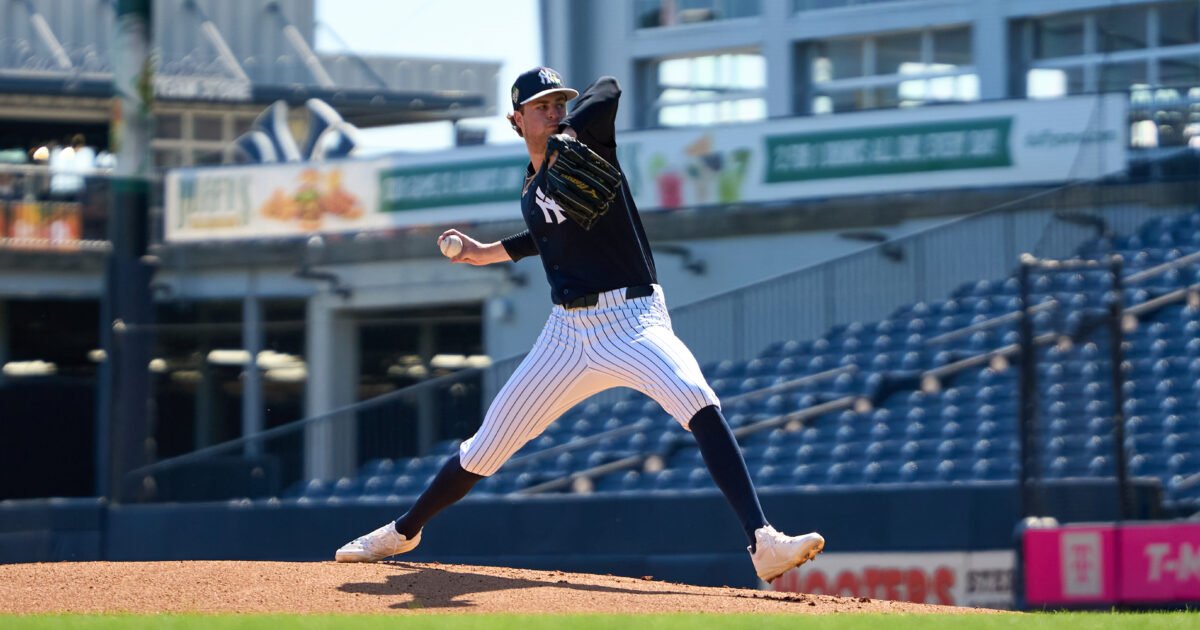
Cam Schlittler has been the story of the first half. He is arguably the story of the American League. The 25-year-old leads the AL in ERA (1.50), FIP (1.90), and WAR (2.9), posting a chase rate and walk rate in the 98th–99th percentile of the entire league. The Yankees took him in the seventh round of the 2021 draft. Seventh. What Matt Blake and this organization have developed in Schlittler is a legitimate Cy Young frontrunner, a homegrown ace under control through 2032, and one of the most exciting pitchers in baseball.
But Schlittler hasn’t had to carry this alone. Max Fried picked up right where his 2025 campaign left off, delivering elite contact suppression and a sub-2.10 ERA over his first two months. Will Warren, now working from the left side of the rubber, arrived in spring training with a 1.42 ERA and has been a legitimate mid-rotation asset. And Gerrit Cole came back.
Cole returning from Tommy John surgery is the kind of development that reshapes a rotation’s ceiling mid-season. His first extended outing in Kansas City, 6 2/3 scoreless innings, 10 strikeouts, and zero walks announced that the former Cy Young winner is not just a name on a lineup card. He’s a weapon again. The rotation led the majors in WAR at one point this season.
Bullpen: B
This bullpen will drive you to the medicine cabinet. It will also, apparently, prevent runs.
Through late June, New York’s relief corps owns a 3.39 ERA, fifth-best in the majors and a 3.69 FIP that checks in eighth. By fWAR they sit ninth, with the modest innings total reflecting how consistently the rotation has kept them out of games rather than a lack of effectiveness when called upon.
David Bednar remains a legitimate late-inning weapon. Fernando Cruz leads the ‘pen with a 31.9 percent strikeout rate, the 18th-best mark in the league. The hard contact suppression has been elite — their 28.3 percent hard contact rate leads the major leagues. Their HR/9 (0.85) ranks fourth.
What this bullpen lacks is swing-and-miss volume. Their overall strikeout rate sits at 22.5 percent, league average for relief pitching. There is no arm currently in this group capable of blowing through a lineup at 40 percent K rate. The absence of that kind of high-octane, chase-inducing reliever is why watching this ‘pen can feel more nerve-wracking than the results warrant.
Camilo Doval and Jake Bird have struggled since arriving. Tim Hill appears to have lost a step. The depth is thin enough that any injury or sustained ineffectiveness could cascade quickly, which is why “upgrade the bullpen at the deadline” remains the most credible front office priority for the second half. Even with a group that on paper looks better than it feels from the couch.
Offense: B-
The Yankees’ lineup is good. It is also, in some notable ways, a problem.
The top third is legitimate. Ben Rice has been one of the most productive hitters in the American League, posting a team-leading 22 home runs and 56 RBIs while carrying a barrel rate and expected slugging that validate the counting stats. Cody Bellinger has elevated his game in Aaron Judge’s absence and become a true run producer. Paul Goldschmidt, at 38 years old, has been one of the best surprises in the sport, hitting .295 with 14 home runs and 40 RBIs while ranking in the 78th percentile in Batting Run Value and 76th in barrel rate at Baseball Savant. Carlos Rodón’s quote about Goldschmidt being a Hall of Famer isn’t hyperbole, it’s data.
Jazz Chisholm Jr. has been inconsistent but flashes the dynamic, all-around profile the Yankees acquired him for. José Caballero has delivered exactly what his Statcast page has always suggested he could: quality defense, positional versatility, and just enough on-base contribution to hold a lineup spot.
Then comes the bottom of the order, and things get uncomfortable.
The McMahon-Wells pairing has been, statistically, one of the worst three-slot combinations in baseball. Ryan McMahon is hitting .210/.269/.360 in 69 games. Austin Wells is at .164/.268/.252. Collectively, the 7-through-9 spots are hitting .196 with a 28.0 percent strikeout rate, dead last in baseball at that slot. The expected statistics are slightly kinder, but not enough to make the watching experience less painful.
Then there’s Aaron Judge. The reigning three-time MVP is on the shelf with a rib cage stress fracture expected to cost him multiple months. That this lineup has survived his absence at all speaks to the genuine depth the organization has built, and importantly, to how this year’s team differs from past Yankees squads who crumbled without their captain. Scoring 5.42 runs per game without Judge compared to 5.17 with him isn’t just survivorship optics; it reflects how many legitimate bats now surround the injury.
But surviving Judge’s absence and actually thriving in the second half with a bottom-third of the order this bad are different things. The catcher market is worth monitoring.
Organizational Narrative: Surviving Without Judge, And What It Means
The most significant subplot of the first half has been a genuinely new storyline for this franchise: the Yankees aren’t falling apart without Aaron Judge.
In Judge’s absence this year, the Yankees have produced more runs per game, a higher batting average, and more home runs per game than when he played. The 2026 team has defied the pattern of the last several years. That’s not because Judge isn’t irreplaceable. It’s because the Yankees front office has built genuine roster depth behind their superstar for the first time in a long time. Goldschmidt filling the righty pop void, Rice emerging as a franchise-caliber bat, Bellinger producing in a lineup anchoring role. None of that was guaranteed.
The credit goes to Brian Cashman and his staff, that spent this offseason patching holes rather than gambling on stars. But depth isn’t a second-half plan. A healthy Judge is still the difference between a deep playoff run and a first-round casualty.
The Second Half Agenda
Three items the Yankees need to address before August 1:
1. Bottom-third offensive reinforcement. Whether it’s a catcher upgrade, a bench infusion, or creative lineup manipulation, the McMahon-Wells-Volpe situation cannot be the postseason version of this team.
2. Bullpen punch. The relievers have gotten by on contact management and walk prevention. That formula gets tested in October. One high-strikeout arm, ideally with true swing-and-miss stuff would change the calculus significantly.
3. Workload management for the rotation. Cole is coming back from major surgery. Fried has a bone bruise history. Rodón’s hamstring and elbow situation required monitoring all spring. These arms are too valuable to sacrifice on early-October exhaustion.
The 2026 Yankees are a legitimate contender. Their rotation is the best in the American League. Their offense has enough quality at the top to carry the bottom through the regular season. But the gap between a good regular season team and a World Series winner runs through the bottom of the lineup, the back of the bullpen, and the durability of a pitching staff that has been asked to carry a lot of weight since Opening Day. The second half is where we find out which version of this team shows up.