The New York Yankees CJ Abrams Flirtation
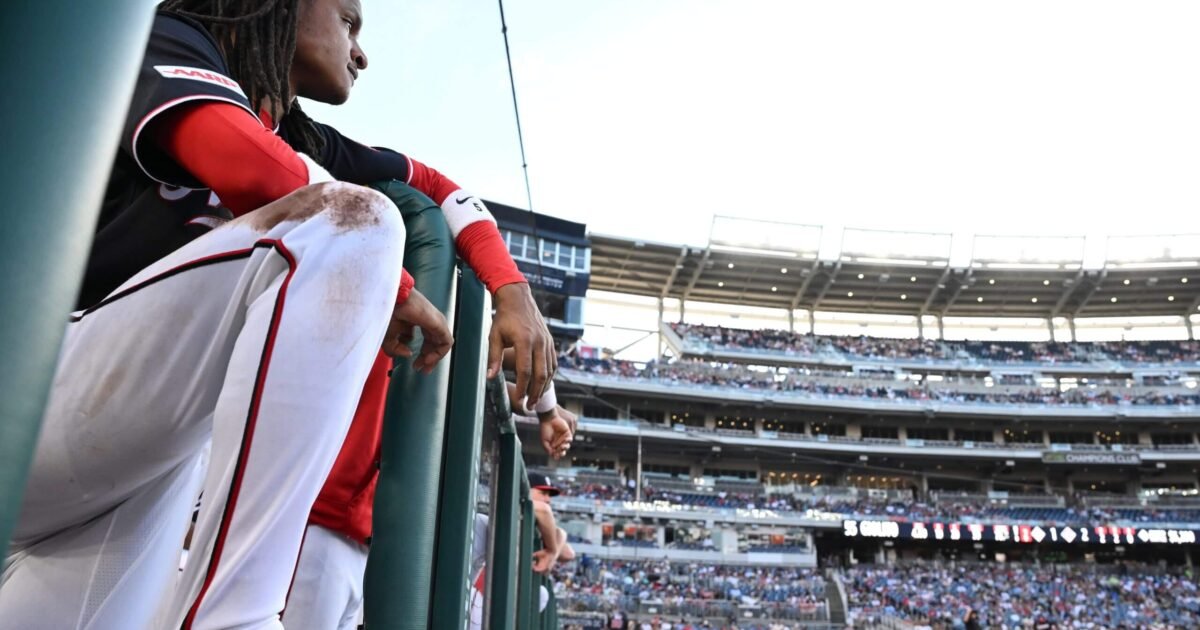
With the August trade deadline nine days out, the New York Yankees are being connected to Washington Nationals shortstop CJ Abrams with increasing regularity. Unlike some of the smokescreen rumors that circulate every July, this one has real substance behind it. The Athletic’s Spencer Nusbaum and Will Sammon reported the Yankees have shown genuine interest, ESPN’s Jeff Passan and Kiley McDaniel listed New York among the “best fits” if Washington deals him, and multiple outlets have floated Abrams as the centerpiece of a potential infield overhaul that would finally push Jose Caballero and Anthony Volpe out of the everyday shortstop picture.
The fit is easy to understand on its face. The Yankees have a gaping offensive hole at shortstop and Abrams is having a career year. But “best offensive shortstop available” and “correct move for this specific roster” aren’t always the same sentence, and the defensive numbers on Abrams are bad enough that this deserves a real look before anyone in the Bronx starts planning the introductory press conference.
Why New York Is Even Here
This trade candidacy exists because of the season Volpe hasn’t had. New York optioned the Gold Glove-winning shortstop to Triple-A Scranton/Wilkes-Barre in early May following a torn labrum rehab, and José Caballero, who’d been holding down the position well in his absence, has started the bulk of the Yankees’ games at short since. Caballero is a legitimately useful defender and a fine complementary piece, but he’s never been miscast as an everyday offensive threat, and with Aaron Judge missing extended time on the injured list, New York’s lineup has cratered in ways a glove-only shortstop can’t fix.
That’s the actual driver here. This isn’t a defense-first search. It’s the Yankees looking at a lineup that’s lost its best hitter for two months and deciding the shortstop spot is the easiest place to add a bat without touching the outfield or first base mix.
What Abrams Actually Brings
The offensive profile is real, not a small-sample mirage. Abrams is running a .275/.352/.510 slash line with 20 homers and 67 RBI, numbers that have helped push Washington into a tie for the MLB lead in runs scored. That’s a substantial jump from the player Yankees fans might remember from his earlier, more erratic seasons. This looks like a legitimate breakout, not just a hot streak that happened to coincide with trade season.
He’s also 25 with two years of club control remaining after this season, which matters enormously for how the Yankees would value this over, say, a rental bat. If Cashman is going to pay a real prospect price, doing it for a player who’s controllable through 2028 rather than a two-month rental is the only version of this deal that makes long-term sense.
The Glove Is the Real Problem
Here’s where the analytics get uncomfortable. For the second straight season, Defensive Runs Saved and Outs Above Average have both panned Abrams’ shortstop work, and it’s not close. Outs Above Average has him at a brutal -57 for his five-year career. That’s not a metric quibble or a small-sample flaw in one system; two independent defensive models agreeing that badly, over that long a track record, is about as strong a signal as advanced defensive metrics can give you.
The ESPN evaluators McDaniel and Passan talked to made the same point in blunter terms, saying flatly that evaluators simply don’t think he’s a good shortstop, and defensive metrics firmly agree which is exactly why, despite ranking Abrams among the best position players plausibly available, that same report only gave him a 15% chance of actually being traded given the exceptional return Washington’s front office would seek.
This creates a real fork for New York. Abrams has some experience at second base and even a bit of outfield work, so one version of this move has the Yankees sliding him to second, bumping Jazz Chisholm Jr. to third, and turning Ryan McMahon into a glove-first bench piece. The other, likelier version has New York just living with the defensive shortfall at shortstop and pushing both Caballero and Volpe into part-time roles. Given how badly the offense needs the bat right now, that second scenario is probably what actually happens if a deal gets done. However, it means the Yankees would be knowingly downgrading their infield defense to chase a lineup fix.
Is It Actually a Big Upgrade?
Offensively, unambiguously yes. There’s no realistic version of Anthony Volpe or José Caballero’s bat that competes with a .275/.352/.510 shortstop hitting 20-homer, 67-RBI pace. Volpe’s career-long swing-and-miss issues and Caballero’s light-hitting, glove-first profile are exactly the kind of holes a player like Abrams was built to fill, and with Judge banged up, the Yankees need thump more than they need a plus glove at short.
Defensively, it’s a real step back, and not a marginal one. A -57 OAA over five years isn’t a player who’s “underrated defensively” or a stat that’s lying to you; it’s a shortstop who costs his team outs in the field at a rate that will show up on the scoreboard. The honest framing is that this isn’t a clean upgrade so much as a trade of defensive runs for offensive ones, and the Yankees would be betting that the offensive gain outweighs what they’re giving back with the leather. It’s a bet that gets easier to justify in a pennant race where every run matters, and harder to justify if it meaningfully raises the walk-off-loss column.
There’s also the asset cost to weigh. Washington’s demanding price has scared off suitors before, Milwaukee reportedly walked away from an Abrams pursuit last offseason for exactly that reason. Early reports are connecting Yankees outfield prospect Spencer Jones to potential packages suggest New York would have to give up real, near-MLB-ready talent to get this done. That’s a fair price to pay for a middle-of-the-order bat with multiple years of control. It’s a much tougher price to justify for a shortstop your own advanced metrics say is actively hurting you in the field.
Bottom line
CJ Abrams would be a significant lineup upgrade and a real defensive downgrade at the same position, and the Yankees would be making a calculated bet that the former outweighs the latter down the stretch. Whether that’s the right bet depends less on Abrams’ bat, which is clearly good, and more on how much more losing the pitching staff can absorb if the defense behind it gets worse.