
Carlos Lagrange Will Succeed Out of the Bullpen for the New York Yankees in 2026
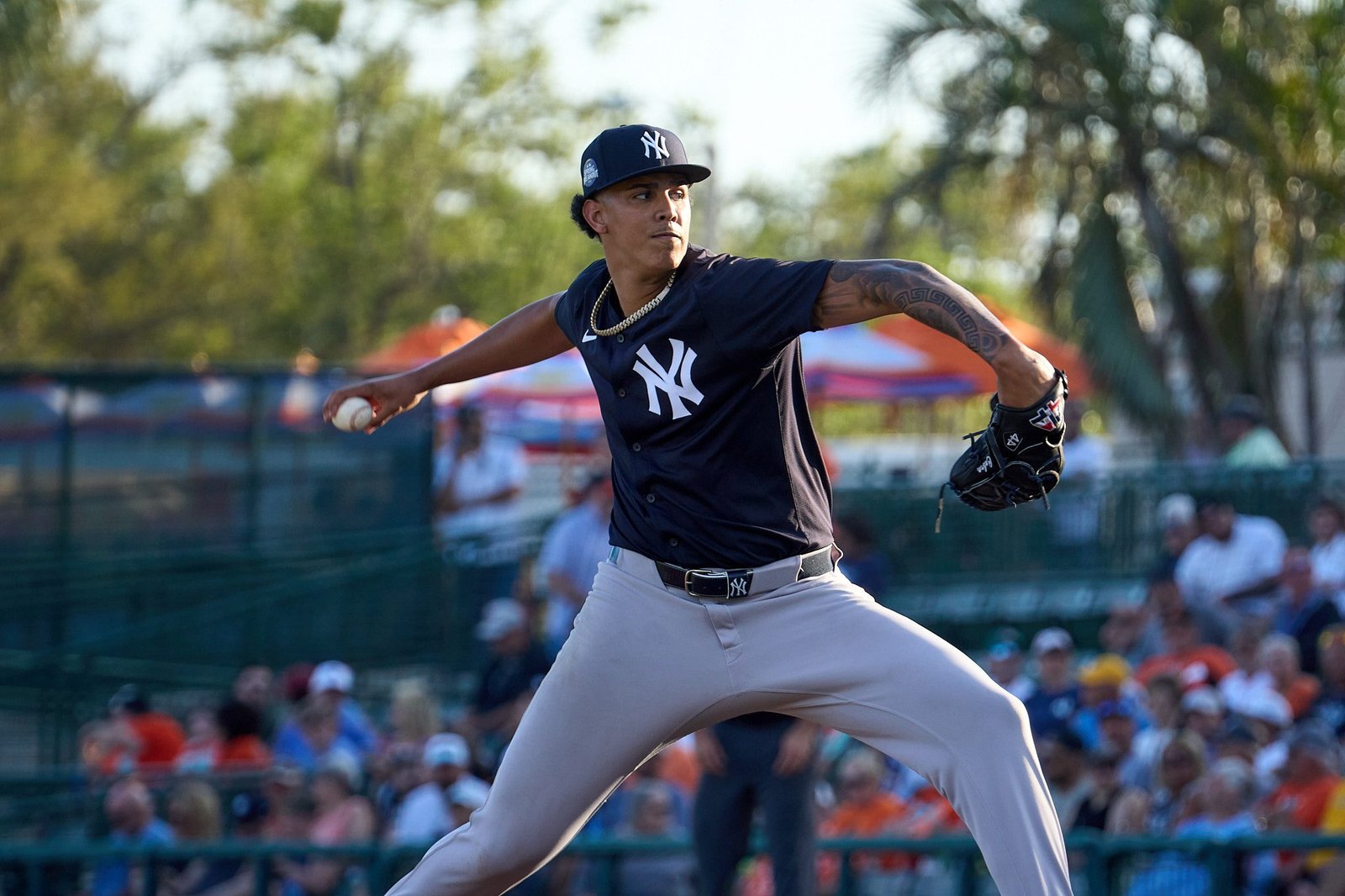
There is a number that ends most arguments about Carlos Lagrange before they start, and it is not an ERA. It is 103.1. That is the velocity, in miles per hour, of the single fastest pitch any Yankee pitcher threw all spring. The second-fastest, 102.8, also belonged to him, on the same March afternoon against Toronto. A 6-foot-7, 248-pound right-hander the Yankees signed out of Bayaguana, Dominican Republic for $10,000 in February 2022 is now the loudest arm in the organization, and the only real question left about him is where that noise should play.
The temptation in the Bronx is to keep projecting Lagrange as a starter, because that is what he has always been and because the upside of a triple-digit starter is enormous. But the cleaner, faster, more defensible path to him helping the 2026 Yankees runs through the bullpen, and the case for it gets stronger every time you look past the surface line.
The stuff is already a bullpen weapon
Start with what is not in dispute. Lagrange’s four-seam fastball carries a 70 grade from MLB Pipeline, sits around 99-100 as a starter, and has touched 102-103 in both spring and the regular season. He has paired it this year with a new sinker living around 99, and he rounds out the arsenal with a slider, a sweeper, a cutter, and a changeup. That is not a one-trick velocity arm; in his best Triple-A start of the season, on April 23 at PNC Field, he recorded all of his strikeouts using four different pitches and ran a 43.2 percent whiff rate over five innings.
Now apply the relief multiplier. A fastball that sits 99-100 across 90 pitches typically plays up two to three ticks in one-inning bursts, which would push Lagrange’s floor velocity into the 101-103 band he currently only touches. The secondaries that he has to ration as a starter, picking two or three to feature on a given night, collapse into a “throw your two best, max effort, every pitch” attack. For a pitcher whose stuff is already plus-plus, the bullpen is not a demotion. It is an amplifier.
The command problem shrinks in short stints
The knock on Lagrange is real and worth stating plainly: he walks people. FanGraphs has long flagged the mechanical roots of it. A long-limbed delivery with significant head movement and spinal tilt that he struggles to repeat, which makes consistent strike-throwing hard. Through his first handful of Triple-A starts in 2026 he has carried an ERA in the low 4s with the walk rate to match, and that is precisely why he has no obvious lane in a rotation that currently leads the majors in ERA and K-BB%.
But command degrades over a start. It is at its sharpest in the first time through an order, before fatigue, before the delivery starts drifting in the fifth and sixth innings. A reliever lives almost entirely in that first-time-through window. Lagrange’s April 23 outing is the tell: 15 first-pitch strikes to 21 batters, one walk, eight strikeouts. When he is fresh and attacking, the strike-throwing is there. The bullpen is the role that asks him to be fresh and attacking and then takes the ball away before the wheels can come off.
There is also a development logic to it. Shortening Lagrange to a two-pitch, max-effort look, fastball and his best breaker, removes the cognitive load of managing a five-pitch mix and lets him simplify his delivery around one repeatable release. That is not a theory. It is the exact blueprint this organization has run before.
The Betances precedent is sitting right there
If the comparison feels familiar, it should. Dellin Betances was a hard-throwing Dominican right-hander with elite stuff and starter command questions who was stuck at Triple-A Scranton, the very same minor league affiliate Lagrange calls home today, when the Yankees moved him to the bullpen in May 2013. They narrowed his focus to two pitches, tightened the delivery, and watched him strike out 83 batters in 60 innings before the call-up. He then turned into one of the most dominant setup men of his era.
The parallels are not perfect, but they rhyme loudly: same body type, same origin, same command profile, same affiliate, same organization that has already proven it knows how to flip this kind of arm. The Yankees have institutional memory for converting a power righty whose starting path is blocked by walks. Lagrange is the most physically gifted version of that profile they have produced since Betances himself.
The opportunity is open now
The final piece is timing, and it favors him. David Bednar anchors the closer role, but the surface results around him have been uneven, and the bridge innings have been turbulent. Camilo Doval, brought in to be a high-leverage piece, has been scuffling badly. A contender that leads the league in rotation ERA does not need Lagrange to make 30 starts. It needs strike-throwing power arms in the seventh and eighth innings, and it needs them this summer, not in 2027.
That is the role Lagrange’s stuff is built for, the role his command profile is best suited to survive, and the role the roster most urgently needs filled. Beat reporters covering the team have already said they would be stunned not to see him pitch out of the Bronx bullpen at some point this season. The pieces all point the same direction.
The bottom line
None of this forecloses Lagrange’s future as a starter. The Yankees can and probably will keep stretching him out at Scranton, banking the innings, betting on the command catching up to the stuff over the next couple of seasons. That is the right long-game.
But the question was about this season, and for 2026 the answer is clean. Put a fastball that floors at 101 and a wipeout breaker into one-inning bursts, ask the delivery to hold together for 15 pitches instead of 90, and let a contender’s bullpen absorb the upside. Everything that limits Carlos Lagrange as a starter, the walks, the inconsistent release, the limited innings either disappears or stops mattering the moment he becomes a reliever.
The stuff was never the question. The bullpen is the answer.