
Is David Bednar Still the Answer for the New York Yankees in the 9th?
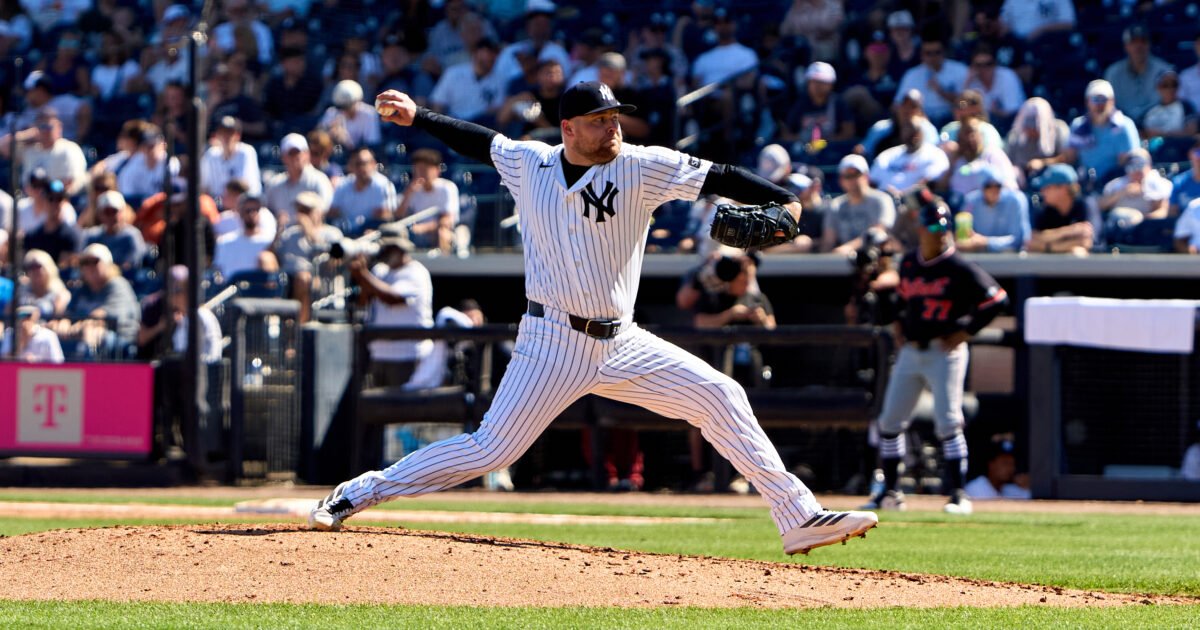
David Bednar allowed a three-run homer to Tyrone Taylor with two outs in the ninth inning on Sunday, turning a 6-3 Yankees lead into a tie game and eventually a 7-6 Subway Series loss in ten innings. It was the kind of moment that demands a real answer to a question the Yankees have been quietly avoiding: is Bednar still the right closer for this team?
The surface numbers do not inspire confidence. A 4.95 ERA. A 1.55 WHIP, nearly 40 points above his career average of 1.18. Two blown saves. Allowed at least one base runner in 15 of 20 appearances. A walk rate that has ballooned to 10.9%, the worst mark of his career. But the Statcast data tells a more complicated story.
The xERA Gap
Here is the number that should frame the entire conversation: Bednar’s xERA sits at 2.42, nearly a full run and a half better than his actual ERA of 4.95. That is one of the largest expected-to-actual gaps among closers in baseball this season.
His Statcast percentile rankings underscore the point. He ranks in the 98th percentile in chase rate, meaning hitters are chasing out-of-zone pitches against him at an elite level. His barrel rate against sits in the 94th percentile, and his ground ball rate is in the 96th percentile. He is, by process metrics, pitching like a very good closer.
The problem is sequencing and timing. Batters leading off an inning against Bednar this season have combined for a .313 average and a .421 on-base percentage. With two outs, opposing hitters are hitting .308 against him with a .756 OPS. He acknowledged it himself postgame Sunday: “Just not putting guys away early. It’s unacceptable, especially in that spot.”
That is the contradiction at the core of the Bednar problem. The stuff is good. The command in critical moments is not.
The Velocity Dip
One metric worth watching that the raw ERA doesn’t capture: Bednar’s average fastball velocity has dropped from 97.1 mph in 2025 to 95.9 mph in 2026. A drop of 1.2 mph may not sound alarming in isolation, but for a pitch that functions as his primary setup offering before deploying the split-finger fastball, it matters.
The split-finger remains his best weapon, it generated the key strikeouts in Monday’s save against Toronto after Sunday’s collapse. But when the fastball loses a tick, hitters can better time the sequencing and sit on the split. The Taylor homer Sunday was a reminder that even Bednar’s best pitch can get punished when the setup preceding it is hittable.
The Walk Problem
Perhaps more concerning than any individual blow-up is the walk rate. Bednar has already issued as many walks through 21 appearances in 2026 as he had in 22 appearances with the Yankees during the entire second half of 2025. His 2.65 BB/9 is elevated, and the elevated ground ball rate, currently 56.3%, well above his career mark of 44.1%, may actually be a byproduct of missing the zone more and inducing weak contact on pitches left over the plate.
When closers start missing the zone, it changes how hitters approach them. They lay off breaking balls, work counts, and wait for a mistake. Sunday’s Taylor homer was exactly that, a hitter who worked the count and sat on something over the plate.
Is There an Alternative?
The Yankees’ bullpen does not currently have a clear closer alternative. Camilo Doval, acquired to be a high-leverage piece, has posted a 6.14 ERA over 14.2 innings. Fernando Cruz has been solid as the primary setup arm but is not a natural ninth-inning option. Brent Headrick has been the bullpen’s best-kept secret with a 1.47 ERA and elite underlying metrics, but he is a left-handed specialist rather than a true closer.
Bednar is not losing his job. He shouldn’t, not yet. The underlying Statcast data is too good to dismiss, and the small sample of blown saves does not override a career of closing success. Aaron Boone has made clear he trusts Bednar’s mettle, and the bounce-back save Monday in Toronto, 36 pitches, a walk, a run allowed, and still got Vladimir Guerrero Jr. to end it, showed exactly why.
What the Yankees cannot afford is to walk into October with one volatile ninth-inning option and no premium fallback plan. The July trade deadline conversation for New York will center on bullpen depth, the most urgent need.
What to Watch Going Forward
The key indicators to monitor for Bednar over the next four to six weeks:
- Fastball velocity: Does it creep back toward 97 mph as the weather warms and his arm gets right, or does it continue to sit at 95–96?
- Leadoff walks: His inability to put away the first hitter in an inning is the single biggest driver of high-stress appearances. If that number improves, the ERA will follow.
- xERA vs. ERA convergence: With elite chase and barrel rates, regression toward his expected numbers is reasonable to project. The question is whether a catastrophic blown save occurs before the numbers normalize.
Bottom Line
David Bednar is not a bad closer. He is a closer going through an inflated ERA stretch driven by sequencing problems and elevated BABIP on balls in play, not a collapse in underlying pitch quality. The Statcast profile remains excellent. The split-finger is still a premium weapon.
But the Yankees need Bednar to be dominant in October, not survivable. The front office should use the next six weeks to monitor whether the velocity and command settle, and simultaneously identify a secondary high-leverage arm via trade that takes the pressure off the ninth inning as a single point of failure.
Sunday was a warning. The answer is not panic, it is preparation.