
Gerrit Cole Is Set To Make His New York Yankees Return This Friday
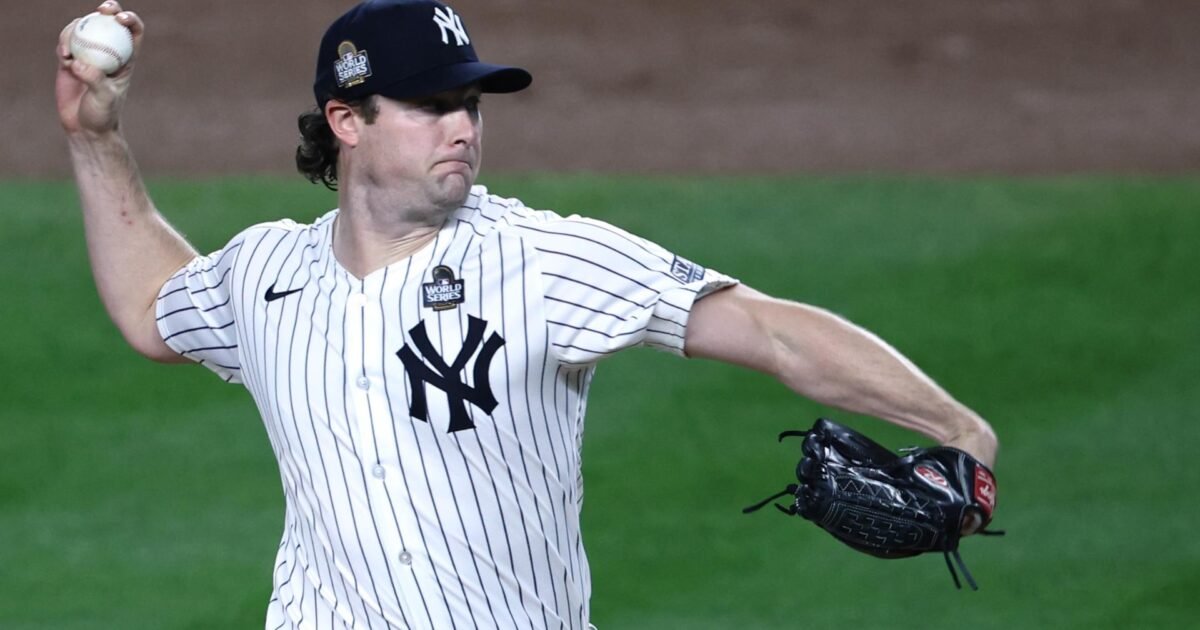
Gerrit Cole touched 99.6 mph in the third inning of his sixth minor league rehab start last weekend. For a pitcher who spent over a year recovering from Tommy John surgery, that single data point matters more than his 4.71 ERA across 28⅔ rehab innings. The Yankees faithful should not be looking at that ERA. They should be looking at the velocity curve, the arsenal shape, and what history tells us about TJS returns. Let’s break it down.
The Velocity Story
Cole’s most pressing concern entering 2026 was not whether he could pitch, it was whether the stuff would come back. In his final healthy stretch before the elbow started betraying him in 2024, Cole was averaging 97–98 mph on his four-seam fastball with regularity. When the elbow inflammation first surfaced mid-2024, his average fastball dipped below 96.0 mph for the first time in seven seasons. That was the red flag long before the surgery became unavoidable.
So when Cole sits 96.9 mph on his four-seamer and 96.8 mph on his sinker in a rehab start, and peaks at 99.6, that is not a pitcher coming back diminished. That is a pitcher whose arm is alive.
According to Brooks Baseball, Cole’s 2026 rehab arsenal currently features his four-seamer and sinker sitting in the 96-mph range, supplemented by a curveball at 82, a slider at 89, and a changeup at 87. That is essentially the full pre-injury menu. The shape and sequencing of his arsenal, not just raw velocity, will tell us the most about his sustainability once he enters the rotation.
The TJS Return Blueprint
Tommy John surgery with an internal brace, the procedure Cole underwent in March 2025, typically offers a more optimistic velocity prognosis than traditional TJS. The internal brace augments the UCL repair with a synthetic ligament, allowing for a more stable recovery and, in many cases, a faster return to peak velocity.
Historically, elite starting pitchers returning from TJS show a predictable pattern: velocity is often close to pre-surgery levels upon return, but command and pitch sequencing take another 6–12 months to fully normalize. Shane Bieber, Sandy Alcantara, and Noah Syndergaard each showed strong velocity on return before tightening their command windows in the months that followed.
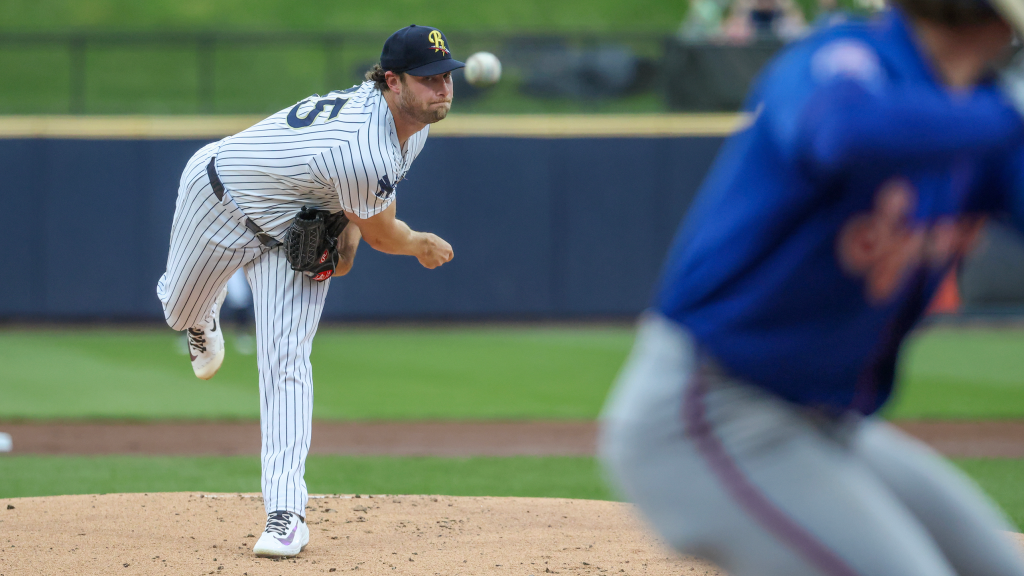
For Cole, the 65.1% strike rate and six hits allowed across four innings in his most recent rehab outing are less alarming than they might appear. He walked zero and generated nine whiffs, which suggests the elite pitch-to-contact profile is still there. The hits are noise. The whiffs are a signal.
What to Realistically Expect
Cole’s career Statcast profile is historically elite. His 2023 Cy Young season featured an xERA under 2.90, a chase rate in the 90th percentile, and a barrel rate in the top 5% of the league. The underlying peripherals, K-BB%, xwOBA against, and hard-hit rate were the kind of numbers that don’t evaporate after surgery. They erode slowly if the mechanics slip.
The mechanics have not slipped. Yankees manager Aaron Boone has outlined a plan for Cole to rejoin the rotation on Friday vs Tampa Bay. With Max Fried nursing a bone bruise and the team sitting at 29–19 with playoff aspirations firmly in view, the timing is nearly perfect. Cole does not need to be the 2023 version immediately. He needs to give the Yankees five or six quality innings, let the defense work, and layer in his command as the summer progresses. Given the velocity signal from last weekend, that is a realistic baseline, not a hope.
Bottom Line
The 99.6 mph peak is the headline, but the full data picture is what should give Yankees fans confidence. The velocity is back. The arsenal is intact. The whiff rate is trending in the right direction. And the team he is returning to, one with a rotation ERA that has led the AL for most of the season, is not asking him to carry anyone.