The One That Got Away: Why the New York Yankees Had to Sign Juan Soto
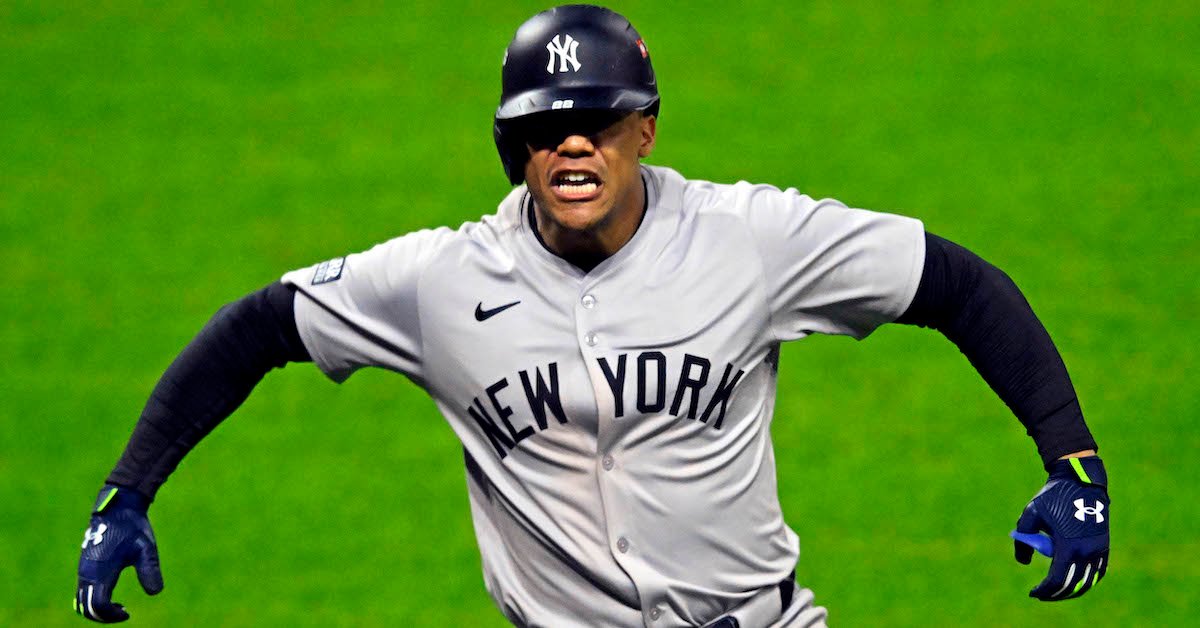
There are moments in franchise history that define eras, decisions made, or not made, that echo for decades. The New York Yankees know this better than anyone. The Babe Ruth trade. The Derek Jeter dynasty. The 2009 championship. Now, in the other direction, there is Juan Soto.
When Soto departed the Bronx in December 2024, signing a jaw-dropping 15-year, $765 million contract with the New York Mets, the largest in professional sports history, it wasn’t just a free agent loss. It was a seismic shift in the balance of power in New York baseball. The Yankees had the player. They had the money. They had the history. And they still couldn’t close the deal.
This is the story of why they had to and why letting him walk may haunt this franchise for years to come.
The Case Was Never Complicated
The analytics community can often overcomplicate what the eye test makes obvious. Juan Soto is a “generational” talent, a player who arrives in the sport fully formed in a way that only a handful of players ever do. But for those who prefer the numbers, the argument is just as airtight.
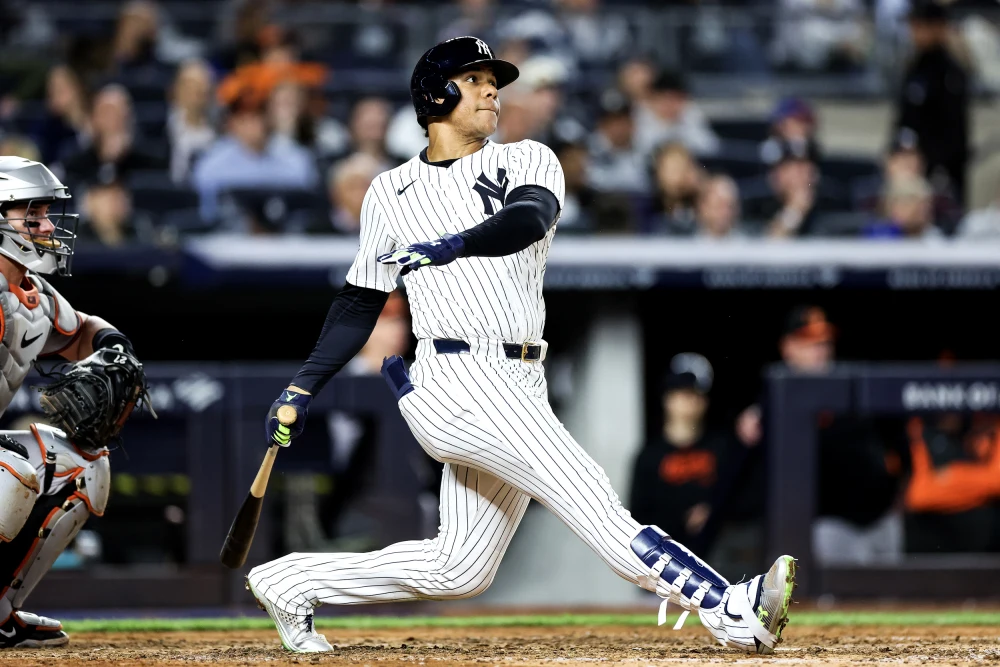
In 2024, Soto posted a .288/.419/.569 slash line with 41 home runs, 109 RBIs, and 128 runs scored. Good enough for his career-best across nearly every offensive category. He finished third in American League MVP voting and authored 8.1 fWAR, fourth-best in all of baseball. That kind of production, at age 25, on a roster built around Aaron Judge, isn’t just complementary, it’s transformative.
His career OBP of .421 is the best among all active Major Leaguers. Consider what that means next to Judge, who sees pitches differently when there’s a threat in front of him. The protection Soto provided in the lineup wasn’t incidental. It was structural. It was the reason the 2024 Yankees offense became something genuinely dangerous.
And when the lights were brightest? Soto’s three-run home run in Game 5 of the 2024 ALCS ultimately clinched the Yankees’ 41st American League pennant, their first trip to the World Series since 2009. One swing. One at-bat. One player who rose when everything was on the line.
The Yankees needed to sign Juan Soto because Juan Soto is exactly the kind of player who wins championships.
The Window Is Real (and It’s Not Infinite)
The urgency to retain Soto was never just about his talent in isolation. It was about timing.
Aaron Judge, perhaps the greatest right-handed hitter of his generation, is on the back half of his prime. Gerrit Cole had Tommy John surgery and was set to miss the entirety of 2025, meaning he won’t return to a big league mound until likely after turning 35. Giancarlo Stanton’s body has made a habit of betraying him. The farm system, productive as it has been in recent years, does not carry a wave of impact arms ready to reinforce a rotation under pressure.
World Series windows don’t stay open. They creak, they narrow, and eventually they shut. Sometimes with a force you don’t see coming. The 2024 team was built specifically for this moment: a Judge-Soto tandem that gave opposing pitching staffs no clean answers. Take Soto out of that equation and you’re asking everyone else on the roster to be something they are not.
The Yankees built their roster around an aging core with few top-level prospects nearing the big leagues and an injury-prone slugger on a massive salary through 2027. In that context, Soto wasn’t a luxury, he was the load-bearing wall.
What the Numbers Say… The Yankees Lost
Advanced metrics have a way of quantifying what gut instinct already knows. Soto’s 8.1 fWAR in 2024 didn’t just represent his individual contribution, it represented the multiplier effect he had on every lineup card he appeared on.
His 178 OPS+ in 2024 would have topped the all-time Mets record of 169, set by Howard Johnson in 1989. Let that sink in. The player the Yankees let walk to Queens was operating at a level that would have been the single greatest offensive season in Mets franchise history.
His walk rate is elite. His swing decisions are among the best in baseball. He makes contact when contact is needed and selects his spots with the patience of a veteran twice his age. These are not skills that age poorly in the short term. Soto at 26 figures to be Soto at 35 and possibly beyond.
He entered free agency having played 936 career games with a .285/.421/.532 slash line, 201 home runs, and 36.3 career fWAR. That’s a Hall of Fame trajectory at an age when most players are still finding themselves in Double-A.
Close Wasn’t Enough
The Yankees offered Soto a 16-year, $760 million contract, a staggering number by any measure, and a clear signal that ownership understood the stakes. But the Mets, under Steve Cohen, went one step further. The biggest free agent contract in MLB history became officially a battle between the two New York teams, and when it was over, it was Queens that had won.
Brian Cashman, upon receiving the news from Scott Boras that they had fallen short, acknowledged Soto’s impact directly: “He impacted us in a heavy way. I’m just sorry we fell short in the World Series, but he — with others — had a great part in getting us where we did, becoming American League champs in 2024.”
That quote, measured and professional as it was, understated the reality. This wasn’t about falling a few million dollars short. This was about losing the second-best player on your World Series roster to your crosstown rival. A rival with an owner who has made it explicitly clear he intends to compete at the highest level for years to come.
In the aftermath, the Yankees leaned on a reshuffled roster, headlined by lefty ace Max Fried, All-Star closer Devin Williams, and former MVPs Cody Bellinger and Paul Goldschmidt, and a wave of young position players to absorb Soto’s departure. Admirable pivots, all of them. But pivots nonetheless.
The 2025 Yankees won 94 games and tied for the American League’s best record, only to be eliminated by Toronto in the ALDS. Good enough to contend. Not good enough to win. Without Soto in the middle of that lineup, the ceiling had already been lowered before Opening Day.
What Comes Next
The Yankees remain a franchise of enormous resources and genuine ambition, however, the path to a World Series without Juan Soto requires more things to go right. More health to hold, more young players to arrive ahead of schedule. It requires pitching to stay healthy in October and a lineup that can manufacture runs without the most disciplined hitter in the American League setting the table. It requires, in short, a series of fortunate events that baseball rarely provides on command.
The Yankees needed to sign Juan Soto because great players, truly great players, change the math of everything. They change how opponents construct a roster, how managers deploy a bullpen, how hitters approach their at-bats one spot removed in a lineup. Soto’s departure didn’t just cost this team 8.1 fWAR. It cost them a type of offensive certainty that is almost impossible to reconstruct through committee.
The Bronx had its chance. It was one year, one unforgettable postseason, one $5 million gap that now stands as one of the most consequential decisions in the franchise’s recent history.
The window was open. The player was there. And now he’s wearing blue and orange.